How Do You Align a Portfolio with Strategy? A Portfolio Strategic Alignment Framework


TL;DR
We align portfolios with strategy by converting executive priorities into measurable selection criteria, requiring evidence before proposals advance, and making funding and capacity choices visible by objective. This guide gives PgMP candidates an auditable framework for intake, scoring, allocation, benefits tracking, diagnosis, and quarterly rebalancing.
How Do You Align a Portfolio with Strategy? A Portfolio Strategic Alignment Framework
PMI’s 2026 research involved 2,534 participants, including project professionals and senior leaders across regions and industries. Sponsor agreement at initiation matters, but it does not by itself prove that the whole investment mix follows strategy.
Use a portfolio strategic alignment framework to turn executive priorities into measurable selection criteria, require evidence before a proposal enters the pipeline, and allocate funding and capacity to the objectives that matter most. Then review benefits, risk, dependencies, and strategy each quarter, pausing or ending work when the portfolio mix no longer reflects the priorities.
We will show PgMP candidates how to design those controls, test whether a problem is strategic or operational, and make alignment auditable rather than rhetorical.
What Does Strategy-Aligned Portfolio Management Actually Mean?
A strategically aligned portfolio is not a list of projects that all mention a corporate goal. It is a deliberate mix of investments whose funding, people, expected benefits, dependencies, and risk exposure visibly support the priorities executives have chosen. The APM definition similarly connects portfolio management to selection, prioritisation, control, strategic objectives, and delivery capacity.
For PgMP candidates, this distinction matters because a project can deliver its approved scope on time and still be the wrong investment. Portfolio alignment asks whether the combined work advances the organisation’s intended outcomes. Project performance asks whether an approved component is being delivered well. Those are related questions, but they are not interchangeable.
Most drift begins before delivery. Priorities may be vague or unranked. Sponsors may submit work through disconnected intake channels. Local incentives can reward starting projects rather than freeing capacity. Delivery dashboards can focus on cost and schedule while ignoring whether benefits remain relevant. When those controls are weak, each project may appear sensible in isolation while the total portfolio underfunds the three-year plan.
The practical test is simple: can the PMO show which objectives receive the most discretionary funding and scarce capability, then explain why? If not, strategy is probably being narrated rather than governed. Our portfolio governance learning path helps connect this enterprise view to the reasoning expected of senior program leaders.
How Does a Portfolio Strategic Alignment Framework Translate Strategy into Criteria?
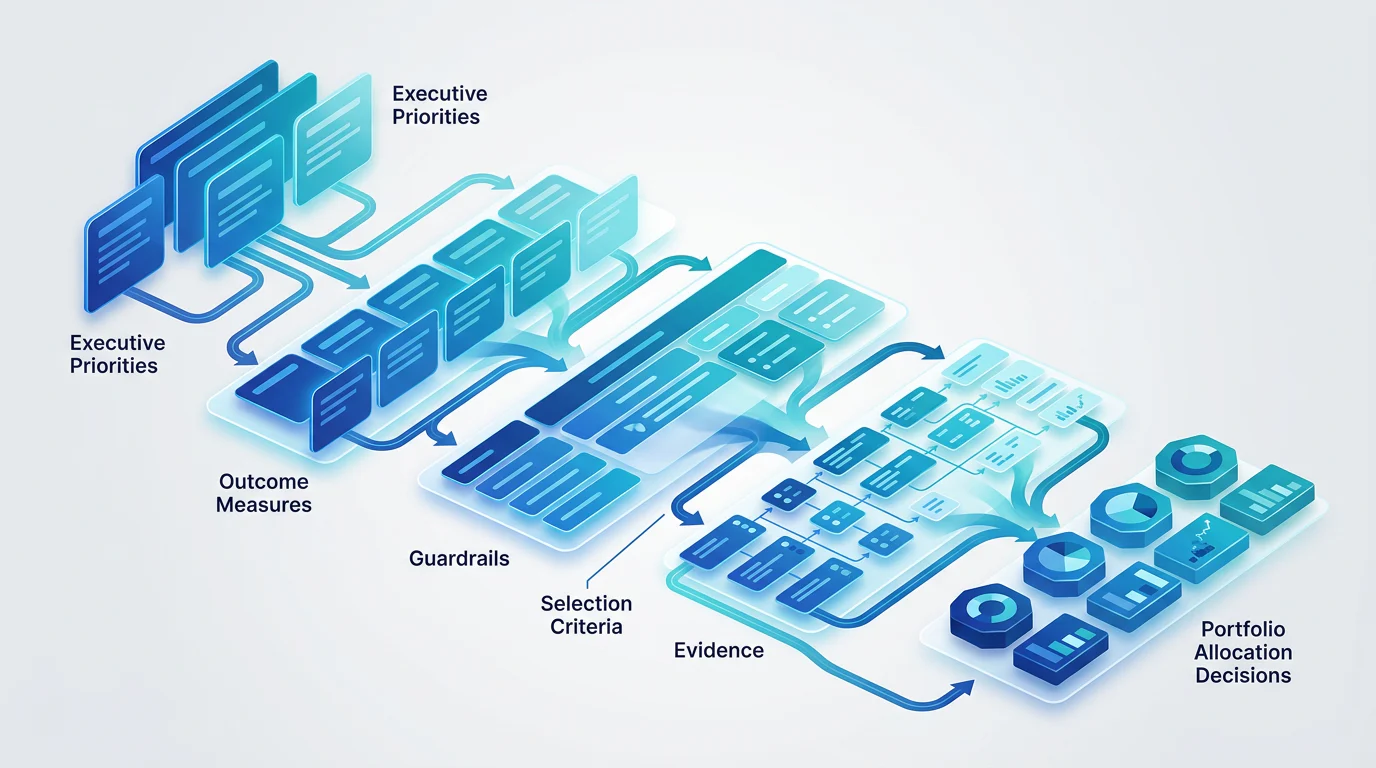
A portfolio strategic alignment framework creates a chain from executive intent to investment decisions. It makes it harder for every proposal to claim equal importance, because each claim must connect to a named outcome, a defined measure, and a visible trade-off.
The chain should run from strategic priority to outcome measure, target, guardrail, weighted criterion, proposal evidence, and portfolio allocation. The Green Book describes this policy-to-portfolio-to-project relationship as a “golden thread,” which is a useful standard for traceability.
Define Outcomes Before Naming Projects
Start with a small set of executive priorities stated as outcomes, not activities. “Improve customer retention” is directionally useful, but it is too broad to score. A usable version identifies the intended outcome, the baseline, the target, the benefit owner, and when evidence should be available.
This does not require false precision. It requires disciplined ownership. If an outcome cannot yet be measured reliably, the proposal should state what discovery is needed before a major commitment. That is better than assigning a confident score to an unsupported claim.
Set Guardrails Alongside Weights
Weights communicate what matters most. Guardrails protect the portfolio from choices that look attractive in a scoring model but exceed capacity, breach risk appetite, depend on unavailable capabilities, or overload the business with change.
Mandatory and regulatory work should be tracked separately from discretionary strategic work. It may deserve funding, but forcing it through the same contribution score can conceal the actual investment trade-off. A board needs to see both the mandatory commitment and the remaining capacity available for strategic choices.
Make Criteria Comparable Across Proposals
Each criterion needs a common definition of strong, moderate, weak, and unsupported contribution. A proposal should not receive a high strategic rating merely because its sponsor is senior or its narrative is polished. Require evidence of the causal link, expected benefit, timing, alternatives, and dependencies.
Use the same criteria for new work and in-flight components. That comparison is where a project prioritization framework becomes more valuable than a one-time intake form. It gives the governing body a consistent basis for choosing among proposals, not just approving them one at a time.
What Must a Project Prove Before Business-Case Development?
The strategic intake gate should occur before teams invest heavily in business-case development. Its purpose is not to reject ideas prematurely. Its purpose is to reserve detailed analysis for ideas that have a plausible strategic contribution and a visible place in the constrained portfolio.
Ask three questions at the gate. First, which named strategic outcome will this work materially influence? Second, what evidence supports the baseline, target, benefit owner, and claimed contribution? Third, what funding, capacity, dependency, risk, and opportunity-cost trade-off would admission create?
A proposal that cannot answer the first question should not move forward as a strategic investment. A proposal with an uncertain answer to the second may deserve discovery work, but not a full commitment. A proposal that ignores the third has not yet been evaluated as portfolio work.
- Strategic Contribution: Name one primary objective and explain the mechanism through which the work changes it.
- Benefit Evidence: Record the baseline, target, owner, expected timing, confidence level, and method of measurement.
- Portfolio Impact: Identify required skills, funding profile, critical dependencies, risks, and work that may need to slow or stop.
- Decision Class: Mark the proposal as discretionary, mandatory, enabling, or exploratory so comparisons remain honest.
GAO recommends that selection processes predefine the decision data and procedures used to assess projected outcomes, benefits, costs, and resource allocations. Its investment framework also warns against letting isolated business needs or the availability of funds dominate portfolio decisions.
For PgMP preparation, this gate creates defensible governance language: executives decide strategic intent, portfolio governance decides investment fit, and program leadership supplies credible evidence. We explore the broader judgment behind that distinction in strategic initiatives.
How Do You Measure Portfolio Alignment Rather Than Project Rhetoric?
Measurement is where strategy stops being a slide deck. The portfolio view must aggregate the allocation pattern across objectives, then compare that pattern with the priorities and guardrails leadership approved. A project score alone is not enough because a collection of individually acceptable projects can still produce the wrong mix.
PMI’s portfolio guidance treats funds, expected benefits, resources, dependencies, risks, and performance expectations as strategic planning inputs. Its portfolio standard supports measuring and comparing components throughout their life cycle, rather than treating approval as the last strategic decision.
Build an Alignment Scorecard
The scorecard should test allocation, not merely intent. It should separate mandatory work from discretionary work and flag missing evidence rather than pretending missing information is a neutral result.
| Measure | Calculation | Governance Question |
|---|---|---|
| Funding By Objective | Approved and forecast spend grouped by objective | Does money follow stated priorities? |
| Capacity By Objective | Named skills and available capacity grouped by objective | Do scarce people follow stated priorities? |
| Benefits Coverage | Forecast and realised benefits against objective targets | Is investment translating into outcomes? |
| Risk Exposure | Aggregate exposure against approved appetite | Is the mix collectively tolerable? |
| Dependency Readiness | Critical dependencies resolved or on track | Can benefits be realised when planned? |
| Unlinked Investment | Funding and capacity without a valid objective link | How much portfolio drift remains? |
The most important discipline is comparison with agreed intent. A percentage of funding is meaningful only when leaders have documented what they intended to emphasise and why. If that intent changes, update it visibly instead of quietly changing the scorecard.
Use a Project-To-Objective Allocation Table
The portfolio board needs one view that joins strategy and delivery reality. A project-to-objective allocation table makes gaps visible, including overconcentration, unsupported benefits, hidden capacity conflicts, and dependencies that prevent an otherwise attractive project from generating value.
| Objective | Component | Funding View | Capacity View | Expected Benefit | Risk And Dependencies | Decision |
|---|---|---|---|---|---|---|
| Growth Outcome | Programme Or Project | Planned And Forecast Spend | Required Skills And Availability | Measure, Owner, Timing | Exposure And Critical Links | Fund, Reshape, Pause, Or Stop |
| Efficiency Outcome | Programme Or Project | Planned And Forecast Spend | Required Skills And Availability | Measure, Owner, Timing | Exposure And Critical Links | Fund, Reshape, Pause, Or Stop |
| Resilience Outcome | Programme Or Project | Planned And Forecast Spend | Required Skills And Availability | Measure, Owner, Timing | Exposure And Critical Links | Fund, Reshape, Pause, Or Stop |
For exam-oriented practice, the table reinforces a central lesson: portfolio decisions are made on aggregate value, strategic fit, constraints, and risk, not on project narratives alone. See portfolio management coverage for more on how portfolio-level governance differs from managing a single project.
Specify a Portfolio Heat Map
A heat map should place objectives on rows and show funding, capacity, benefit confidence, risk exposure, and dependency readiness as columns. Use labels and symbols alongside colour so the view remains accessible. Flag mandatory work, unlinked investment, and material variance from approved allocation.
Benefits need baselines, targets, owners, and dates to remain testable. The UK government’s benefits guidance notes that benefit realisation is difficult to determine without a target and calls for specific measures, baselines, owners, and dates.
A heat map does not make the decision for the board. It makes the decision conditions visible. That distinction is useful when building a PgMP study stack that emphasises reasoning over memorised vocabulary.
How Do You Rebalance the Portfolio When Strategy or Evidence Changes?
Rebalancing is the proof that alignment is a management system rather than an annual workshop. Quarterly review is a practical cadence because it gives leaders a recurring point to test strategy changes, emerging evidence, benefits forecasts, capacity constraints, dependencies, and risk concentration before sunk cost becomes the dominant argument.
Start each review by asking whether the executive priorities remain current and measurable. If not, this is a strategy-definition problem. If priorities are clear but were never applied consistently at intake or selection, it is a portfolio-design problem. If the selected mix remains valid but delivery or benefits are failing, it is an execution problem. That diagnosis matters because each failure needs a different intervention.
Senior program leaders must often make these decisions across teams that do not report to them. Our guide to cross-functional leadership explains the influence needed to carry portfolio decisions across functions.
Use explicit decision rules:
- Fund Or Accelerate: The component closes an objective gap, has credible evidence, and fits capacity and risk guardrails.
- Reshape: The objective remains valid, but scope, sequence, dependencies, or benefit assumptions need revision.
- Pause: A critical evidence, capacity, or dependency condition is unresolved by the next review point.
- Terminate: The strategic link is obsolete, benefits no longer justify investment, or continuing blocks higher-priority work.
- Reclassify: A material strategy change has altered the work’s purpose, even if delivery performance remains sound.
Portfolio reviews should retain the criteria, evidence, rationale, allocation movement, and expected benefit effect behind every decision. GAO advises reviewing portfolios at agreed intervals and adjusting resource allocations as necessary, while its review guidance calls for documented criteria and decision rationale.
Termination should be normal governance, not a public failure ritual. When leaders can explain why assumptions changed, they can release capacity with less defensiveness and make better choices about the work that remains. Our termination framework provides a focused way to structure that conversation.
How Can Augment Consultancy Help You Practice Portfolio Alignment?
At Augment Consultancy, we help experienced program leaders turn portfolio theory into defensible PgMP judgment. Our work starts with the decisions that matter in applications, case discussions, and senior leadership rooms: how to trace strategy to benefits, judge trade-offs across constrained capacity, and explain why a project should continue, pause, or stop. We use realistic portfolio situations instead of memorized definitions, so you practice recognizing the difference between a weak strategy, weak selection controls, and weak execution evidence. You can pressure-test your reasoning, learn how governance choices affect benefits realization, and build language that remains clear under exam-style scrutiny. If you are preparing for PgMP responsibility as well as certification, our learning approach helps you connect program outcomes to enterprise priorities without reducing portfolio management to a scoring spreadsheet. Explore our programs, learning resources, and point of view at Augment Consultancy.
FAQs on Portfolio Strategic Alignment Framework
What Is the Underlying Issue When Project Selection Feels Disconnected from Strategy?
The underlying issue is usually a selection and allocation control failure: priorities were not converted into mandatory criteria, or funding and capacity were never tested across the portfolio.
Is a Portfolio Design Issue Different from an Execution Issue?
Yes. Design concerns the chosen mix, sequencing, allocations, and risk exposure. Execution concerns whether approved work delivers its promised scope, benefits, timing, and cost as planned.
How Do You Measure Portfolio Alignment?
Measure the combined portfolio, not project statements: compare funding and capacity by objective with approved intent, then track benefits, dependencies, risk exposure, and unlinked investment.
Should Mandatory Work Use the Same Alignment Score?
No. Track mandatory work separately, assess its delivery and risk requirements, then make its capacity and funding impact explicit before comparing discretionary strategic investments during selection.