How Do You Learn Portfolio Governance? A Portfolio Governance Learning Path


TL;DR
We help experienced program managers learn portfolio governance by moving from delivery control to investment decision-making. This 12-week pathway covers a skills diagnostic, governance forums, decision artifacts, readiness evidence, and when to choose a practical workshop or PfMP preparation for senior work.
How Do You Learn Portfolio Governance? A Portfolio Governance Learning Path
Experienced program managers often discover that strong delivery controls do not answer leadership’s harder question: are we funding the right work? PMI research reports that organizations with mature project portfolio management practices complete 35% more programs successfully. We cover the role shift, skill gaps, decision system, practical learning route, and credential choice required to make that transition.
A portfolio governance learning path helps experienced program managers move from controlling delivery to governing investment choices. It builds strategic alignment, intake and prioritisation, funding and capacity allocation, portfolio risk, decision rights, and benefits oversight through recognised standards, a baseline assessment, working artifacts, and repeated executive decision practice.
How Does Portfolio Governance Change a Program Manager’s Job?
Program governance helps related work deliver an intended outcome. Portfolio governance looks across programs, projects, and operational change to decide what should receive scarce funding, specialist capacity, executive attention, or no further investment at all.
| Dimension | Program Governance | Portfolio Governance |
|---|---|---|
| Decision Object | Related delivery components | The investment mix across change initiatives |
| Core Accountability | Coordinated outcomes, benefits, and dependencies | Strategic alignment, value, capacity, risk, and investment choices |
| Typical Decision | Resolve a delivery trade-off | Fund, defer, pause, stop, or rebalance work |
| Primary Audience | Sponsor and program board | Executives, finance, strategy, and portfolio board |
| Success Signal | Outcomes and benefits delivered | Best-value, feasible investment mix |
The difference is not hierarchy for its own sake. The APM definition frames portfolio management as selection, prioritisation, and control aligned to strategy and delivery capacity. That means a portfolio leader must sometimes recommend sacrificing a healthy project because another investment better fits strategy, risk appetite, or scarce manufacturing and supply-chain capacity.
Your program experience remains valuable. Dependency management, benefit tracking, stakeholder alignment, risk escalation, and executive reporting all transfer. What changes is the decision object: instead of protecting one program’s delivery path, you make trade-offs visible across the whole enterprise. Our capability shifts guide explains why that change can feel uncomfortable even for accomplished program leaders.
What Should You Assess Before Starting Portfolio Governance Training?
Before choosing a course or credential, assess whether your current work already includes portfolio responsibilities. Managing many projects does not automatically mean you have governed a portfolio. The test is whether you have helped compare investments, influence resource allocation, shape strategy-linked priorities, or support decisions to continue, pause, or terminate work.
The current PfMP blueprint groups portfolio capability into strategic alignment, governance, performance, risk, and communications. We use those domains to make an initial assessment practical rather than academic.
Score each dimension from 0 to 3, where 0 means no repeatable practice and 3 means you can produce evidence, explain the decision logic, and improve the process after use.
- Strategy Alignment: Can you connect each initiative to a stated strategic objective and identify work with weak fit?
- Intake And Prioritisation: Can you compare proposals using shared criteria rather than sponsor influence alone?
- Funding And Capacity: Can you expose the gap between demand, available budget, and constrained specialist capacity?
- Portfolio Risk: Can you show risks and dependencies that affect the investment mix, not just one component?
- Benefits Oversight: Can you name benefit owners, baseline measures, forecast dates, and confidence levels?
- Decision Rights: Can you identify who recommends, challenges, approves, escalates, and communicates decisions?
- Executive Communication: Can you present options, consequences, assumptions, and a clear recommendation?
A score below 2 is not a reason to delay learning. It is a reason to select the next exercise deliberately. For example, weak prioritisation calls for a transparent scoring model before a sophisticated dashboard. Our prioritisation framework can help program managers turn competing initiatives into a decision conversation.
What Operating Model Turns Portfolio Data into Executive Decisions?
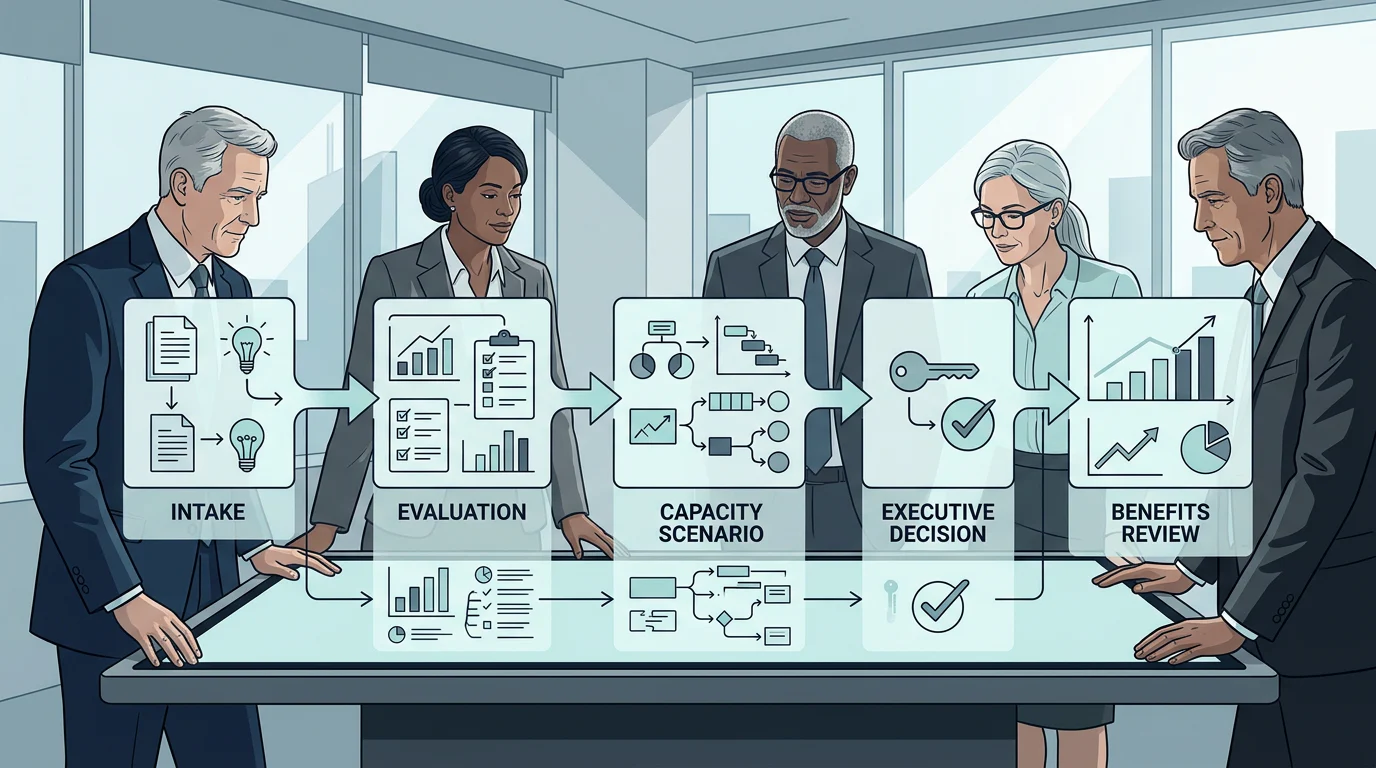
A portfolio governance model is useful only when it creates a reliable route from evidence to a decision. Without named forums, authorities, thresholds, and escalation paths, a portfolio review becomes a longer status meeting where everyone attends and nobody decides.
The government standard distinguishes portfolio governance and management from program and project governance, while linking both to benefits, risk, capacity, reporting, and assurance. We recommend beginning with a deliberately small operating model, then improving it after one real review cycle.
Set Four Decision Forums
Use existing finance, strategy, and executive meetings where possible. The cadence below is an illustrative starting point, not a universal prescription.
| Forum | Illustrative Cadence | Core Inputs | Decision Owner | Required Output |
|---|---|---|---|---|
| Intake Triage | Every two weeks | New proposals, mandatory work, sponsor, strategic rationale | Portfolio lead within delegated authority | Admit, return, or defer |
| Capacity And Finance Review | Monthly | Demand, supply, forecast, funding constraints | Finance and resource leaders | Feasible portfolio scenarios |
| Portfolio Board | Monthly | Ranked options, risks, benefits, decisions required | Executive sponsor or portfolio board | Approve, pause, stop, or reallocate |
| Strategy Refresh | Quarterly | Strategic change, performance, risk, market shifts | Executive leadership | Updated portfolio balance |
Define Decision Rights Before Conflict Arrives
The governance calendar should name who can recommend, challenge, approve, accept residual risk, and escalate. It should also define what triggers escalation: breached risk tolerance, a material capacity conflict, benefit deterioration, funding variance, a failed investment gate, or a strategy change.
A decision log is as important as the meeting itself. Record the options considered, assumptions, evidence, owner, decision, rationale, and next review date. When a project must stop, use a consistent approach rather than treating termination as a personal failure. Our termination framework helps make that decision defensible.
Report Portfolio Health, Not Just Schedule Health
Executives need a view of investment value, benefit confidence, capacity demand, major dependencies, concentration risk, and decisions required. A collection of red, amber, and green schedules can show delivery pressure, but it cannot show whether the portfolio still represents the best use of enterprise resources.
What Does a 12-Week Portfolio Governance Learning Path Look Like?
A working program manager does not need to leave work for six months to establish a credible foundation. We use a 12-week sequence that combines standards-based instruction, mentor feedback, and workplace practice. Our self-paced format includes 24+ hours of video learning, but the more important work happens when learners test each concept against their own live portfolio. Our mentoring guide separates governance coaching from exam-tip-only support.
Weeks One and Two: Establish the Portfolio Lens
Start with the current portfolio boundary: proposed, active, paused, and completed work. Map strategic themes, executive stakeholders, delivery constraints, and current decision forums. Read the relevant portfolio standard, then complete the seven-dimension diagnostic honestly.
The portfolio standard is a useful reference because its fourth edition is principle-based and intended to apply across delivery approaches. We use it as a foundation, then translate it into your operating environment rather than copying terminology into a template.
Weeks Three Through Five: Build Comparative Investment Logic
Create a scoring model that includes strategic fit, expected benefits, risk, dependencies, funding, capacity, and mandatory obligations. Then compare at least two credible portfolio mixes. A single ranked list is not enough when the top-scoring work cannot all be delivered with the same engineers, plants, suppliers, or executive attention.
Weeks Six Through Eight: Design the Decision System
Draft a governance calendar, decision-rights matrix, investment gate, escalation rules, and decision log. Observe an executive forum if possible, or rehearse a review with a mentor. We focus on the question a senior audience actually needs answered: what choice do you recommend, what trade-off does it create, and what happens if leadership chooses differently?
Our practical training approach connects those exercises to real portfolio decisions.
Weeks Nine Through Twelve: Produce Readiness Evidence
Finish with five applied artifacts: a scoring model, governance calendar, investment gate, portfolio risk view, and benefits dashboard. Run one bounded review cycle, document the decision, collect feedback, and revise the artifacts. The resulting evidence is more useful than claiming familiarity with governance vocabulary.
Should You Choose PfMP Preparation or a Practical Workshop?
Choose a practical workshop first when you need to improve a live portfolio’s decisions, reporting, and executive forums. Choose PfMP preparation when you can already demonstrate qualifying portfolio-management experience and need a formal credential pathway. Many experienced program managers benefit from doing both in that order: build credible workplace evidence, then prepare to explain it under formal assessment.
| Situation | Better First Route | Reason |
|---|---|---|
| You need a usable governance model now | Practical workshop and mentoring | Produces artifacts and decision practice |
| You can document sustained portfolio authority | PfMP preparation | Aligns preparation to eligibility, panel review, and exam domains |
| You need both implementation and certification | Workshop, then PfMP preparation | Builds evidence before formal assessment |
| You have delivery experience but limited investment authority | Workshop and expanded responsibilities | Develops evidence before claiming portfolio readiness |
The PMI requirements currently list a 170-question, 240-minute PfMP examination. Candidates with a four-year degree need 96 months of professional business experience and 48 months of portfolio-management experience within the previous 15 years. Candidates with a secondary degree need the same business experience and 84 months of portfolio experience. Current exam fees are US$800 for members and US$1,000 for non-members.
PfMP is not a shortcut around experience. It is a credential for senior practitioners who can demonstrate strategic portfolio work. If your work remains mostly program delivery, use a workshop to expand your decision capability first, then review our credential comparison before investing in preparation.
Build Portfolio Governance with Augment Consultancy
At Augment Consultancy, we help experienced program managers turn broad portfolio terminology into decisions they can defend in an executive room. Our learning approach connects standards to the real work of shaping intake, comparing investments, exposing capacity constraints, documenting escalation, and tracking benefit ownership. We also show how to build a scoring model, governance calendar, investment gate, portfolio risk view, and benefits dashboard without losing delivery discipline. You can learn with certified PgMP® and PfMP® professionals who bring program and portfolio experience to coaching conversations, then test each idea against your own portfolio rather than an abstract case. We can help you decide whether your immediate need is a working governance model, documented application evidence, scenario practice, or a longer credential path. Start by reviewing the learning options, bring one live portfolio decision, and leave with a clearer next move. Explore Augment Consultancy
FAQs on Portfolio Governance Learning Path
How Does Training Work for an Experienced Program Manager?
We start with a capability baseline, teach the governance model, build decision artifacts, and rehearse executive choices against the learner’s current portfolio with mentor feedback.
Where Should I Start with a $40M Portfolio?
Start by defining the portfolio boundary, strategy themes, active investments, decision makers, capacity constraints, and benefit owners, then run one small review cycle before redesigning everything.
How Can I Improve ROI Visibility Across 40 Projects?
Use a common intake record, transparent scoring criteria, capacity and funding scenarios, portfolio-level risk reporting, and a benefits dashboard that shows owners, forecasts, dependencies, and decisions required.