When Should a Portfolio Kill a Project? A Portfolio Project Termination Framework


TL;DR
A portfolio should end a project when fresh evidence shows that continuing no longer beats pivoting, pausing, or moving scarce capacity elsewhere. We show how boards apply pre-agreed kill criteria, evidence-maturity gates, weighted scoring, decision rights, and closure records that protect value and create an auditable decision trail.
When Should a Portfolio Kill a Project? A Portfolio Project Termination Framework
Portfolio decisions become harder when scarce people, money, and attention are spread across too many plausible initiatives. In its 2024 research, PMI reported a 73.8% performance rate across respondents, a useful reminder that delivery status alone cannot tell a board whether an investment still deserves capital.
A portfolio project termination framework should end a project when current evidence shows that its strategic value, expected benefits, feasibility, or portfolio fit no longer justifies the remaining resources and risk. The board should compare continuation with a pivot, pause, scale decision, or capacity reallocation, using pre-agreed criteria rather than executive preference.
We explain the kill conditions, evidence gates, scoring model, decision rights, and closure practices that let PgMP candidates defend portfolio decisions clearly.
When Should a Portfolio Kill a Project Rather Than Fix Delivery?
A late milestone, a missed forecast, or a difficult stakeholder does not automatically mean a project should end. Those are delivery signals. The harder portfolio question is whether the investment thesis still holds after considering current evidence, remaining effort, and the alternatives competing for the same capacity.
A project needs recovery when its strategic purpose and expected benefits remain credible, but execution needs support, a revised sequence, or a tighter scope. It needs termination when the case for spending another unit of money or scarce expertise has materially weakened. PMI portfolio guidance supports periodic review of expected return, risks, dependencies, capacity constraints, and the decision to continue, reprioritize, or terminate.
For PgMP candidates, this is the distinction worth stating precisely: delivery underperformance concerns whether the team can execute; a failed investment thesis concerns whether the organization should keep investing at all. Our PgMP portfolio governance coverage helps connect that distinction to scenario-based exam decisions.
| Outcome | Use It When | Board Action | Capacity Treatment |
|---|---|---|---|
| Continue | The thesis holds and recovery is credible | Authorize the next evidence period | Retain allocation |
| Change | The objective holds but the route does not | Approve a bounded pivot or revised case | Reallocate within approved limits |
| Pause | Timing or a dependency blocks value temporarily | Set a restart trigger and review date | Release capacity temporarily |
| Kill | The thesis no longer clears the criteria | Terminate and transition the work | Reallocate permanently |
| Scale | Evidence exceeds the original case and capacity is justified | Approve a new expansion case | Fund after portfolio comparison |
A board should kill work when a strategic objective is no longer valid, benefits have eroded, a critical assumption has failed, a dependency cannot be resolved, or an alternative creates more value from the same constrained capacity. Sunk cost belongs in the record, but it is not a reason to continue.
Which Project Kill Criteria Belong in a Portfolio Project Termination Framework?
The strongest criteria test the investment case from several angles at once. A project can be on schedule and still be the wrong investment if it duplicates another initiative, consumes a bottleneck role, or no longer advances a priority outcome.
Use seven criteria consistently across the portfolio: strategic alignment, expected benefits, remaining cost, risk, feasibility, dependencies, and portfolio fit. Portfolio fit is where boards consider balance, duplication, shared resources, timing, and opportunity cost. The Treasury appraisal guidance defines opportunity cost as the value of the next-best use of resources, which is exactly the comparison a continuation request must make.
For a healthcare system with multiple hospitals, enterprise criteria should remain common even when evidence is local. Each site can explain clinical context, operating constraints, and adoption readiness. The portfolio board should still compare every project against the same strategic objectives and shared-capacity picture. Candidates working to frame strategic experience can use our PgMP application domains as a prompt to identify the governance evidence in their own work.
Hard-stop conditions need separate treatment. A mandatory safety, regulatory, legal, or critical-success-factor failure should not be averaged away by a favorable score elsewhere. Every other criterion can support a transparent trade-off, but the board should approve the rules before individual projects need them.
What Evidence Must a Project Show at Each Portfolio Stage Gate?
A stage gate should test what the organization can now prove, not whether the project has produced a polished status deck. The evidence becomes more demanding as commitment increases, so a team earns the right to proceed by reducing uncertainty that mattered at the previous decision.
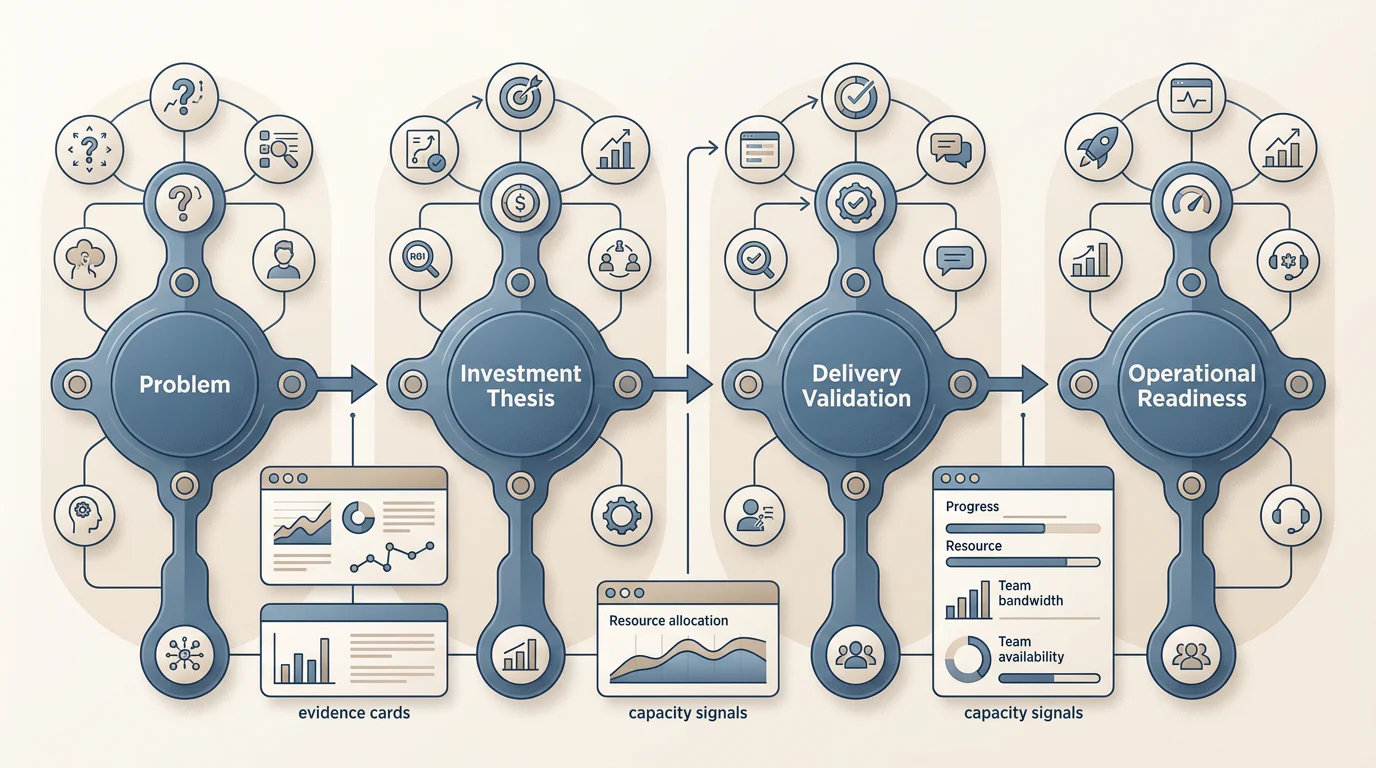
Gate Zero: Is the Problem Worth Portfolio Capacity?
The project owner should establish the measurable problem or opportunity, strategic objective, sponsor commitment, rough scarce-role demand, and consequence of doing nothing. A concept that cannot explain why it deserves capacity this year should not enter detailed analysis.
Gate One: Is There a Viable Investment Thesis?
The evidence should include viable options, expected benefits, critical success factors, initial cost and risk ranges, dependencies, and the reason this route is preferable. The board is funding learning and validation at this point, not treating an early estimate as a permanent promise.
Gate Two: Has Delivery Evidence Changed the Case?
The project team should update the benefits forecast, actual and committed spend, forecast to complete, assumption register, risk exposure, and dependency position. Current Gate 3 guidance similarly expects resource planning, defined accountabilities, decision records, and assurance that continues through closure.
Gate Three: Is the Organization Ready to Absorb Value?
Before release or closure, the board needs evidence of operating-owner acceptance, contracts and support arrangements, adoption readiness, data ownership, benefits measurement, and transition responsibilities. A project can deliver outputs successfully while still failing to create usable value if the receiving operation is unprepared.
| Gate Question | Minimum Evidence | Valid Outcomes |
|---|---|---|
| Is The Problem Worth Capacity? | Strategic problem, sponsor, capacity demand, do-nothing consequence | Analyze, defer, reject |
| Is The Thesis Viable? | Options, benefits logic, risk, dependencies, initial affordability | Fund validation, return, reject |
| Has The Case Survived Delivery? | Updated forecast, assumptions, commitments, recovery options | Continue, change, pause, kill |
| Is Value Ready To Land? | Operating acceptance, transition, benefits ownership, data plan | Release, hold, close |
Candidates can use our PgMP exam readiness scorecard to practice expressing decision evidence with the clarity expected in senior governance scenarios.
How Does a Weighted Score Support Keep, Change, Pause, Kill, or Scale?
A weighted score creates a common language for comparing work, especially when several initiatives are individually attractive. It does not replace judgment, and it must never conceal a hard-stop condition, incomplete evidence, or a material conflict of interest.

Build the Scorecard Around Decision Evidence
Score each criterion against a documented evidence scale, then multiply it by the board-approved weight. Strategic alignment, benefits, remaining cost, risk, feasibility, dependencies, and portfolio fit should total 100 percent of the model, with each percentage approved in the governance charter and version-dated.
| Criterion | What The Evidence Must Show |
|---|---|
| Strategic Alignment | Measurable contribution to a current enterprise objective |
| Expected Benefits | Forecast, accountable owner, and measurement method |
| Remaining Cost | Spent, committed, termination, and forecast-to-complete amounts |
| Risk | Current exposure and the credibility of mitigation |
| Feasibility | Technical, commercial, clinical, and operating viability |
| Dependencies | Critical-path reliance and impact on connected work |
| Portfolio Fit | Capacity, timing, balance, duplication, and opportunity cost |
Set Thresholds Before the Decision
The board should define its continuation, change, pause, kill, and scale thresholds before reviewing a live candidate. It should also set mandatory criteria that trigger escalation regardless of score. MCDA guidance supports transparent ranking of choices, while cautioning that multi-criteria analysis does not replace detailed appraisal.
Test the Sensitivity of the Recommendation
Ask whether the decision changes if benefits arrive later, feasibility evidence weakens, or a shared specialist becomes unavailable. If a small shift reverses the recommendation, the board has learned that more evidence or a pause may be wiser than an irreversible commitment.
Work a Hypothetical Without Inventing Results
Consider a six-hospital initiative that depends on one shared specialist role and a technology dependency now running late. The project owner updates benefits evidence and forecasts, finance validates commitment, risk challenges the dependency, and portfolio management compares the released role against the next-best initiative. The board then applies its own approved weights and thresholds rather than pretending there is a universal answer. Leaders preparing for governance-heavy scenarios can explore our senior PMO PgMP training.
Who Decides to Stop an Underperforming Project?
The governing portfolio board decides whether work remains in the funded set. The sponsor owns the investment case and recommendation, while the project owner manages delivery within agreed tolerances. Portfolio management prepares the comparable evidence, but it should not quietly replace executive investment authority.
This separation matters in a healthcare system where every hospital wants autonomy. Enterprise governance should own strategy, shared specialists, cross-site dependencies, common criteria, and enterprise capital. Local sites should retain delivery control and local improvement decisions inside their delegated limits. Our enterprise transformation PgMP course examines the strategic leadership perspective behind those choices.
| Decision | Project Owner | Sponsor | Portfolio Management | Finance | Risk | Governing Board |
|---|---|---|---|---|---|---|
| Recovery Within Tolerance | R | A | C | C | C | I |
| Evidence Review And Recommendation | R | A | R | C | C | I |
| Validate Financial Commitment | C | A | C | R | I | I |
| Pause, Kill, Or Scale | R | R | R | C | C | A |
| Reallocate Enterprise Capacity | C | C | R | C | C | A |
R means responsible, A means accountable, C means consulted, and I means informed. PMI’s sponsor decision guide identifies authorization, continuation, change, and stopping as recurring sponsor decisions, which reinforces why continuation cannot be treated as automatic.
The board should require conflict disclosure, independent finance and risk challenge, and a documented response to material dissent. Its decision record should name the evidence reviewed, options rejected, capacity released, authority used, owner, and next review date. That is how teams stop getting whiplash from shifting priorities that nobody can explain.
How Should a Portfolio Close a Stopped Project?
Stopping a project is an operating transition, not merely a funding decision. A poor closure can strand people, leave suppliers unclear, corrupt data ownership, and create avoidable risk for connected projects.
Use a closure checklist that covers both immediate control and future learning:
- People: Redeploy scarce roles, communicate impacts, and assign any residual operational responsibilities.
- Contracts: Confirm stop-work authority, notice requirements, termination costs, supplier handover, and final financial reconciliation.
- Data: Archive evidence, preserve required records, transfer useful assets, and assign accountable data ownership.
- Dependencies: Notify affected initiatives, update sequencing, and release or reassign shared capacity.
- Benefits And Lessons: Assign residual benefit ownership, document disbenefits, and capture lessons before the team disperses.
We provide a downloadable Portfolio Decision Record with this framework so the board can document the original thesis, current evidence, score, alternatives, financial exposure, conflicts, decision rationale, transition actions, and review dates. Closure guidance likewise treats early closure as appropriate when the original need or justification no longer exists.
For PgMP candidates, a well-documented stop can be stronger governance evidence than a project that continued by inertia. It demonstrates strategic alignment, benefits management, risk awareness, stakeholder direction, and responsible use of finite resources. Our PgMP career outcomes page explores how that strategic perspective carries into senior roles.
Build Better Portfolio Decisions with Augment Consultancy
At Augment Consultancy, we help experienced program leaders turn portfolio concepts into defensible judgment under pressure. Our PgMP preparation connects governance language to the choices senior leaders actually face: revalidating benefits, challenging an outdated business case, balancing shared capacity, and recording a decision that can withstand review. We do not teach candidates to memorise a diagram and hope it fits. We use scenario-based practice to help you identify the level of authority, the evidence a gate needs, and the option that protects strategic value. That makes this framework useful for exam preparation and for the meetings candidates return to on Monday. If you are building the strategic perspective required for PgMP, use our practical resources and start with Augment Consultancy Home. We also give you a way to explain why one answer follows portfolio governance while another only solves a delivery symptom.
FAQs on Portfolio Project Termination Framework
When Should a Portfolio Kill a Project?
Kill a project when current evidence shows its strategy, benefits, feasibility, or portfolio fit no longer justifies remaining risk, funding, and scarce capacity versus alternatives.
Is a Schedule Overrun Enough to Stop a Project?
No. An overrun calls for recovery analysis, revised forecasts, and a gate decision. Terminate only when the investment case or portfolio comparison no longer supports continuation.
Who Decides to Stop a Project?
The governing portfolio board should make funded-set decisions. Sponsors recommend, portfolio management organizes evidence, finance validates commitments, and risk challenges exposure before the board records its rationale.
What Makes a Portfolio Stage Gate Useful?
A stage gate tests evidence maturity, not status color. The board compares the current case, viable alternatives, capacity impact, and predefined outcomes before releasing further funding.
When Should a Board Pause Instead of Kill?
Pause when timing, a dependency, or capacity constraint has a credible resolution date. Kill when no evidence-based restart trigger can restore sufficient portfolio value.