

TL;DR
We recommend building a PgMP study stack around distinct jobs: PMI’s current Exam Content Outline controls scope, standards teach concepts, questions diagnose gaps, simulations test pacing, and feedback strengthens panel-review narratives. This guide shows how we audit stale materials, map gaps across all domains, and choose a lean or supported preparation path.
Which Resources Belong in Your PgMP Study Stack?
The current PgMP exam contains 170 questions in 240 minutes, so preparation needs more than a shelf of books or a large question bank. The real challenge is assigning each resource a job and knowing when it has stopped earning its place.
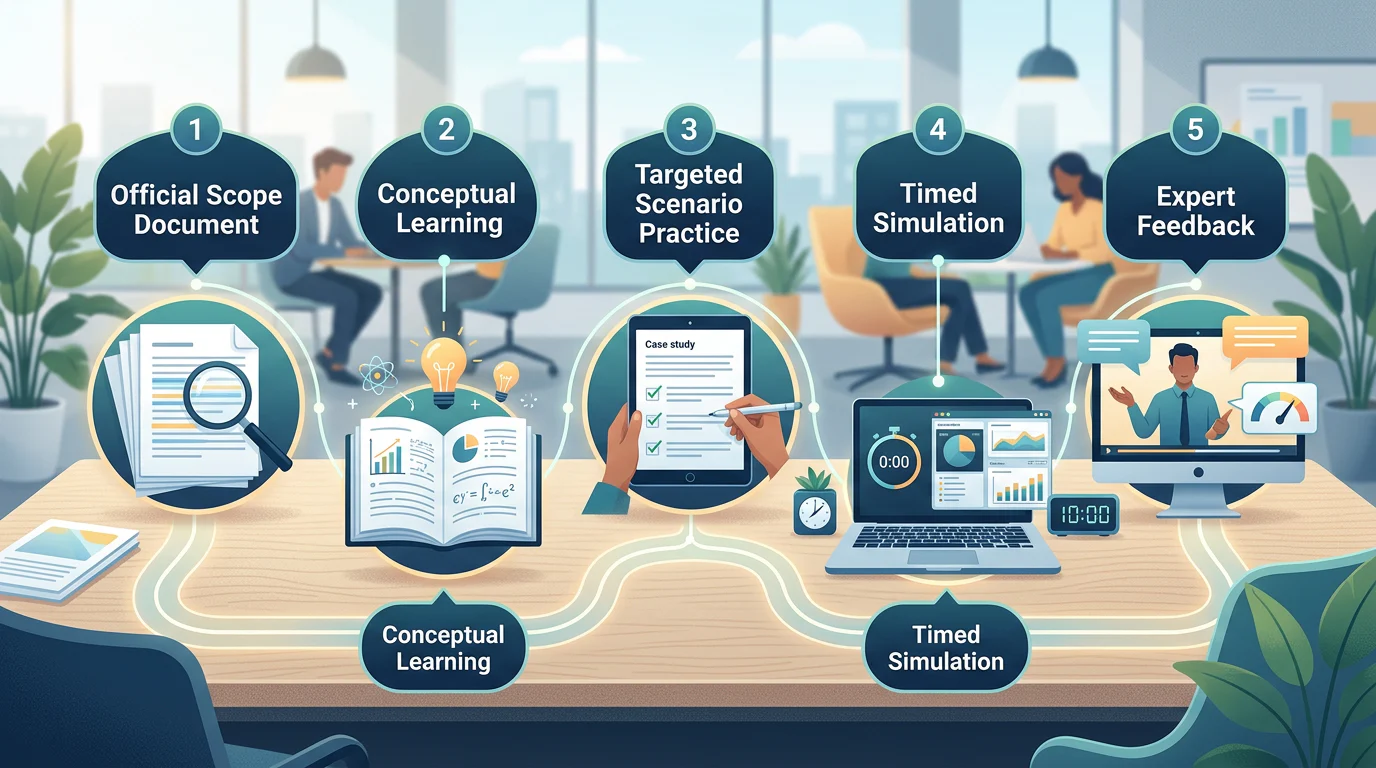
A complete PgMP study stack starts with PMI’s current Exam Content Outline and standards, then adds instruction for difficult concepts, targeted questions for diagnosis, and full simulations for pacing and judgment. No single book, course, or question bank covers every need. Choose each resource for a defined role and remove anything outdated, duplicative, or unsupported.
We will show you how to build that stack, audit it against current PMI material, and add application support only when it solves a genuine panel-review need.
Which Resources Belong in a Complete PgMP Study Stack?
A useful stack is a system, not a collection. We ask candidates to identify the decision each resource helps them make: what to study, how to understand it, where their reasoning breaks down, whether they can sustain exam pace, or whether their experience narrative reads at program level.
The hierarchy below prevents the most common waste: buying multiple resources that all explain the same idea while leaving feedback, scenario judgment, or time management uncovered.
| Resource Type | Primary Job | Authority | Update Check | Strength | Limitation |
|---|---|---|---|---|---|
| Current PgMP ECO | Controls scope and weighting | PMI primary source | Confirm the current document date | Lists domains, tasks, knowledge, and skills | Does not teach concepts |
| Program Management Standard | Builds conceptual understanding | PMI standard | Confirm edition and publication date | Explains program-management principles | Does not define the exam alone |
| Course Or Instructor | Explains difficult concepts | Varies by provider | Require current ECO mapping | Gives sequence and interpretation | Cannot prove exam readiness alone |
| Mentor Or Reviewer | Tests application narratives and judgment | Practitioner dependent | Confirm PgMP and application experience | Adds specific feedback | Does not replace targeted practice |
| Question Bank | Diagnoses domain and task gaps | Varies by provider | Check rationales and ECO alignment | Produces fast error data | Does not replicate full pacing |
| Full Simulation | Tests pace, endurance, and judgment | Varies by provider | Confirm current format and explanations | Integrates knowledge under time pressure | Is inefficient for early learning |
PMI’s March 2024 ECO assigns 44% of the exam to Program Life Cycle Management, compared with 15% for Strategic Program Alignment, 11% for Benefits Management, 16% for Stakeholder Engagement, and 14% for Governance. Those weights should influence study time, but they should not become permission to ignore smaller domains.
Why Each Resource Needs One Job
The ECO tells you what may be assessed. A standard helps you understand why program decisions fit together. Instruction helps when your own experience does not explain a concept clearly. Question banks expose weak reasoning, while simulations reveal whether that reasoning holds up under time pressure.
A mentor or reviewer has a different role again. They can challenge whether an experience summary demonstrates strategy, governance, benefits, stakeholder leadership, and program-level integration. They cannot replace the work of learning the domains or practicing scenario decisions.
How to Use the Hierarchy on a First Attempt
Start with the ECO and one conceptual source. Add a targeted question resource only after you have a way to record mistakes by domain and task. Add full simulations once your targeted results show broad coverage, not at the beginning when a poor score supplies little usable diagnosis.
If you want a structured way to measure those gaps before adding more materials, use our readiness scorecard alongside the hierarchy. The goal is not to own every resource type. It is to know exactly why each remaining resource stays.
How Does the Current ECO Control PgMP Study?
The ECO is the study-scope control document because it gives the current domain weights, tasks, knowledge areas, and core skills. PMI explains that the March 2024 update aligned terminology with the fifth edition of its program-management standard, while exam questions continue to be updated for alignment.
That distinction matters. The ECO and the standard overlap, but the ECO explicitly says the exam-development work was not bound by the standard. A candidate who reads only one reference can learn useful concepts and still miss revised or reclassified exam content.
Build a worksheet with five rows, one for each domain. Add columns for ECO tasks, confidence level, diagnostic results, learning source, practice source, feedback needed, and next review date. That turns vague uncertainty into a visible gap map.
| ECO Domain | Exam Weight | Evidence To Track | Best Next Resource |
|---|---|---|---|
| Strategic Program Alignment | 15% | Business case, road map, strategic fit | Standard or targeted instruction |
| Program Life Cycle Management | 44% | Planning, integration, execution, transition | Deep concept review and scenarios |
| Benefits Management | 11% | Benefits measures, sustainment, transition | Case-based practice |
| Stakeholder Engagement | 16% | Analysis, engagement, communication choices | Scenario questions and review |
| Governance | 14% | Frameworks, controls, decisions, reporting | Standard review and scenarios |
Use the worksheet to decide what to study next, not merely what to buy next. Our exam prep playbook can help you turn the completed map into a realistic study sequence without treating every domain as equally difficult.
Which PMI Standards Support Understanding?
The current Program Management standard should be the conceptual anchor in most stacks. PMI published the fifth edition standard in March 2024, with 247 pages, eight principles, and a new Collaboration performance domain. It is especially useful for understanding how program leadership connects strategic intent, benefits, stakeholders, governance, and delivery.
Start with the Program Management Standard
Read the standard through the ECO, rather than cover to cover without a purpose. When an ECO task is unclear, locate the relevant concept, make a short note in your own words, and then test whether you can apply it in a scenario. This keeps conceptual study connected to examinable work.
Add Project Management Material Selectively
Project-level concepts can matter because programs coordinate constituent projects, but they should enter the stack only where your gap map requires them. PMI’s PMBOK Guide is now in its eighth edition, published in November 2025, so candidates should verify edition and errata information before relying on old notes or borrowed copies.
Keep Application Guidance Separate
Standards support reasoning. They do not replace application evidence. While you are collecting experience examples, use the certification process to understand where application preparation belongs in the broader path. Treat experience summaries as a separate workstream with their own evidence, review, and revision cycle.
How Do You Audit PgMP Resources for Obsolescence?
An outdated resource is not always useless, but it is risky when it presents old terminology or exam claims as current fact. We recommend auditing before you build a study calendar, then revisiting the audit whenever PMI publishes a new ECO, standard, handbook, or certification-policy update.
Check Terminology and Exam Claims
Start with the resource’s publication date, stated edition, and source list. Compare its domain names, standard edition, exam format claims, and panel-review advice with current PMI material. If it cannot show when its content was checked, it cannot serve as your scope-control source.
Before you draft application narratives, use our application documentation rubric to check whether each example shows strategy, governance, stakeholder leadership, and benefits at the program level.
Use a Keep, Replace, or Remove Rubric
| Audit Area | Keep | Replace | Remove |
|---|---|---|---|
| Terminology | Matches current ECO language | Concepts are useful but terms need mapping | Conflicts with current domains or tasks |
| Exam Claims | Matches current PMI format | No date, but facts can be verified | Unsupported guarantees or stale format claims |
| Question Quality | Gives clear, defensible rationales | Useful questions with weak explanations | Recycled items without learning value |
| Source Trail | Names edition, date, and source | Some sources are incomplete | No traceable source or update record |
| Role In Stack | Covers a unique job | Overlaps another source partially | Duplicates a stronger resource completely |
Keep a Source Log
Record the title, resource type, edition, ECO coverage, role, proof URL, checked date, and keep, replace, or remove decision. This log gives you a record of why a source entered the stack and a trigger for reviewing it later.
PMI’s current handbook explains that PgMP panel review includes essay questions assessed by external subject-matter experts with active relevant credentials. That is a useful reminder that materials for exam questions and materials for experience narratives should not be treated as interchangeable.
Remove Duplicate Coverage Before Adding More
Two sources that teach the same concept can be useful briefly. Two similar question banks without distinct rationales usually create repetition, not stronger diagnosis. Keep the source that most clearly maps errors back to the ECO, then use the time you recover for your missing role, such as a simulation or narrative review.
When application evidence needs attention, our application review support can sit beside this audit. It should not become an excuse to delay scope mapping or scenario practice.
How Do You Build a PgMP Study Stack That Fits Your Gaps?
Build from the gap map outward. Candidates with strong program-management experience but uneven PMI terminology may need standards and targeted questions. Candidates who understand the framework but cannot explain their own program leadership may need application feedback earlier. The same package is not the right answer for both.
Start with a Five-Domain Gap Analysis
Rate every domain as confident, uncertain, or weak, then support that rating with evidence. A weak rating needs a reason: low diagnostic accuracy, inability to explain a task, repeated scenario errors, or a missing example from your own experience. Assign one learning source and one practice method to each genuine gap.
Sequence Learning Before Simulation
Use targeted question sets after a learning session, then review every wrong answer by task and reasoning error. A full simulation belongs later, when you can test decisions across all five domains and assess pacing. At 170 questions in 240 minutes, the simulation is a time-management assessment as much as a content assessment.
Add Panel-Review Guidance During Evidence Collection
Start application and panel-review guidance while you organize program examples, not after you have finished all exam study. PMI states that the volunteer panel assesses professional experience summaries after payment and before exam scheduling, so a late narrative review can create avoidable pressure.
Candidates who need that feedback can combine targeted learning with training with application support. Candidates who mainly need structured explanation and accountability should choose support that closes a documented gap, rather than adding material by default.
Choose a Lean or Supported Template
A lean stack contains the current ECO, current program-management standard, one targeted instructional source, one rationales-first question bank, one or two full simulations, and a source log. It suits independent candidates who can explain their gaps and review their own errors honestly.
A supported stack adds structured instruction, application feedback, mentor checkpoints, and guided error review. It suits candidates who need help translating extensive real-world experience into PMI-aligned reasoning and concise program-level evidence.

How Can Augment Consultancy Help You Build a Focused Stack?
At Augment Consultancy, we help experienced program leaders choose support that fits the stage they are actually in, rather than selling a bigger pile of material. If your ECO map exposes knowledge gaps, our training can give you a structured route from concepts to scenario judgment. If your application is the concern, we can focus on the evidence and language that demonstrate program-level leadership. We work with you to turn those choices into an accountable weekly plan. We believe good preparation should make your next action clearer: read one source, solve one gap, request useful feedback, then test the improvement under timed conditions. Whether you are studying independently or want a more supported route, start by defining the role each resource must serve. We also help candidates make study time defensible around demanding leadership responsibilities. Our team can help you decide where feedback will matter most. Visit Augment Consultancy
FAQs on PgMP Study Stack
These answers resolve the final selection questions we hear from candidates after they have mapped scope, assessed material quality, and assigned each resource a role.
Do I Need Both the ECO and the Program Management Standard?
The ECO defines scope and domain weighting. The standard explains the concepts behind that scope, but PMI says the exam is not based on one text alone.
Can a Question Bank Replace a PgMP Course?
Question banks reveal reasoning gaps, but they do not automatically teach the underlying concept or provide individual feedback. Use rationales to route repeated errors back into focused learning.
When Should I Start Panel-Review Preparation?
Begin while organizing application evidence, before exam registration becomes urgent. Because the panel evaluates experience summaries, program-level leadership feedback belongs alongside knowledge study, not after it.
How Should I Use Full PgMP Simulations?
Use targeted sets throughout preparation, then reserve full simulations for broad five-domain review. Simulations should assess pacing and decisions under time pressure, not replace gap diagnosis.
How Often Should I Check Resource Currency?
Check before purchasing, when PMI revises certification content, and whenever a resource makes a claim you cannot trace. Record the document edition, URL, and date checked.