Program Manager Interview Questions: Which Interview Is Yours?
Program manager interview questions depend on the type of role: technical, operations or delivery. Identify the type from the posting, then answer every question with a benefit, a dependency and a decision.

By Sanjeev Kumar, Founder · Updated 9 Oct 2026

Key takeaways
- Program manager interview questions test whether you own an outcome that several projects feed into. The posting tells you which kind of evidence the interviewer wants: technical, operational or delivery.
- Sort the posting into one of three types with three checks. The types are our framework and they overlap, so the posting's first responsibility decides when two fit.
- Prepare six questions, which we expect in any type of role, and answer each with a benefit, a dependency and a decision. We have not verified the six against interview reports.
- Build five practised stories, each holding one number you can defend, and rehearse them aloud. Check each posting's qualifications before assuming you need a credential.
In this article
- 1What do program manager interview questions test, and why does the job type change them?
- 2How can you tell from a posting which type of program manager role it is?
- 3Which six questions should you prepare for in any type of program manager interview?
- 4How do you turn a project manager's answer into a program manager's answer?
- 5How do you build a program manager story bank in one evening?
- 6Does a PMI credential such as PgMP or PMP change the program manager interview?
- 7Frequently asked questions
The same job title can mean two different interviews at one employer. Amazon publishes separate preparation pages for program managers and for technical program managers. Both end in a loop of five 55-minute interviews, but the technical loop includes at least one question on software systems design.
Across employers the spread is wider. In India the title covers operations roles in returns and pricing, technical roles beside engineering teams and delivery roles at chip makers. That is why a generic list of questions fails you. "How do you prioritise?" can be marked on technical judgement in one interview, on metrics in another and on governance in a third. Preparing from the wrong list means rehearsing answers to questions nobody will ask you.
This page gives you a short test for reading a posting, six questions we recommend preparing for, and a story bank you can fill in tonight. It also shows the step most candidates miss: turning a project manager's answer into a program manager's answer.
What do program manager interview questions test, and why does the job type change them?
They test whether you can own a result that several projects feed into, and the employer's version of the job decides which part carries the weight. Amazon's program manager loop assesses program management, stakeholder management and a writing exercise. Its technical program manager (TPM) loop adds a software systems design question and looks at how you handle escalations, as the two Amazon pages linked above set out.
Postings under the title vary just as much. This table groups the first 60 cards from LinkedIn's India search for "program manager" by employer and title only:
| Employer and title | Cards | Detail |
|---|---|---|
| Technical Program Manager in the title | 21 | Amazon 17, Google 4 |
| Amazon, no "Technical" in the title | 25 | Titles name returns, abuse prevention, pricing, catalogue operations |
| Qualcomm, Renesas, Cyient, Quest Global | 10 | Qualcomm 7, one each from the others |
| Other employers | 4 | CrowdStrike, Cialfo, Sova Health, Google (Climate Operations) |
| Total | 60 |
How we counted: on 9 October 2026 we recorded the employer and title of the first 60 cards on LinkedIn's India search for "program manager". Four cards repeat another card's title and location, so there are about 56 distinct roles. Amazon accounts for 42 of the 60. LinkedIn personalises and re-ranks results, so your own search will differ. The table shows the range of employers and titles, not the share of the market, and it does not assign role types. Reading the titles, we infer that the roles run from technical to operational.
Two Amazon India postings show what the operations end asks for. Sr. Program Manager, CMT, in Chennai is a role whose responsibilities cover pricing and customer experience. It asks for 5+ years each of cross-functional work, program or project management and delivering cross-functional projects, plus data and metrics used to drive improvement. Sr. Program Manager, Abuse Prevention, in Bengaluru asks you to set program goals, track key performance indicators (KPIs, the measures a program is judged on) and publish quarterly roadmap updates.
Postings show the skills employers name, not the questions they ask. Our inference is that you should expect questions on exactly those skills.
How can you tell from a posting which type of program manager role it is?
Read the first three responsibilities and run three checks. The types and checks are our framework, not a standard, and one posting can pass more than one.

- Technical checkPass if the title says "Technical", or if any of the first three responsibilities names a system, platform or engineering team you will work with. A pass means preparing to explain how you sequenced work across teams that depended on one another's technology.
- Operations checkPass if the posting says you will own a measure such as defect rate, cost, returns or delivery time. A pass means preparing to show how you set a target, tracked it and moved it.
- Delivery checkPass if the posting mentions a project management office (PMO, the team that sets standards and reporting across projects), governance, a steering committee or several projects reporting to you. A pass means preparing to show how you decided what to start, continue or stop.
If two checks pass, the first responsibility decides. If none passes, ask the recruiter two questions: "What does this program deliver, and how is success measured?" and "Who interviews me, and on what?" Both are reasonable to ask, and the answers tell you which stories to prepare.
Which six questions should you prepare for in any type of program manager interview?
Our recommendation is to prepare these six, which we expect in any type of program manager interview. We have not verified them against interview reports. Each checks whether you manage outcomes or deliverables. Amazon's published preparation names stakeholder management and, for technical roles, handling escalations, which match two of the six.
| Question | What it checks | Weaker answer (our view) | Stronger answer (our recommendation) |
|---|---|---|---|
| What is the difference between a program manager and a project manager? | Outcomes or deliverables | "I manage several projects." | "I own the benefit the projects exist to deliver, and the dependencies between them." |
| How do you prioritise across competing projects? | Criteria | A list of deadlines | A stated criterion, such as contribution to the program's benefit, the trade-off you accepted and who agreed it |
| Tell me about an initiative that was failing. | Judgement | How you rescued it | The point at which you asked whether to continue, the evidence, and who decided, including a decision to stop |
| How do you lead people who do not report to you? | Influence | "I build relationships." | One named stakeholder, what they wanted, what you offered and what changed |
| How do you measure success? | Benefits focus | "On time, on budget." | One benefit (a measurable improvement the program exists to produce), its owner, a date and a measured value |
| When do you escalate a risk? | Governance | "When it is serious." | A threshold agreed beforehand, such as a cost or date limit, and what you brought with the escalation |
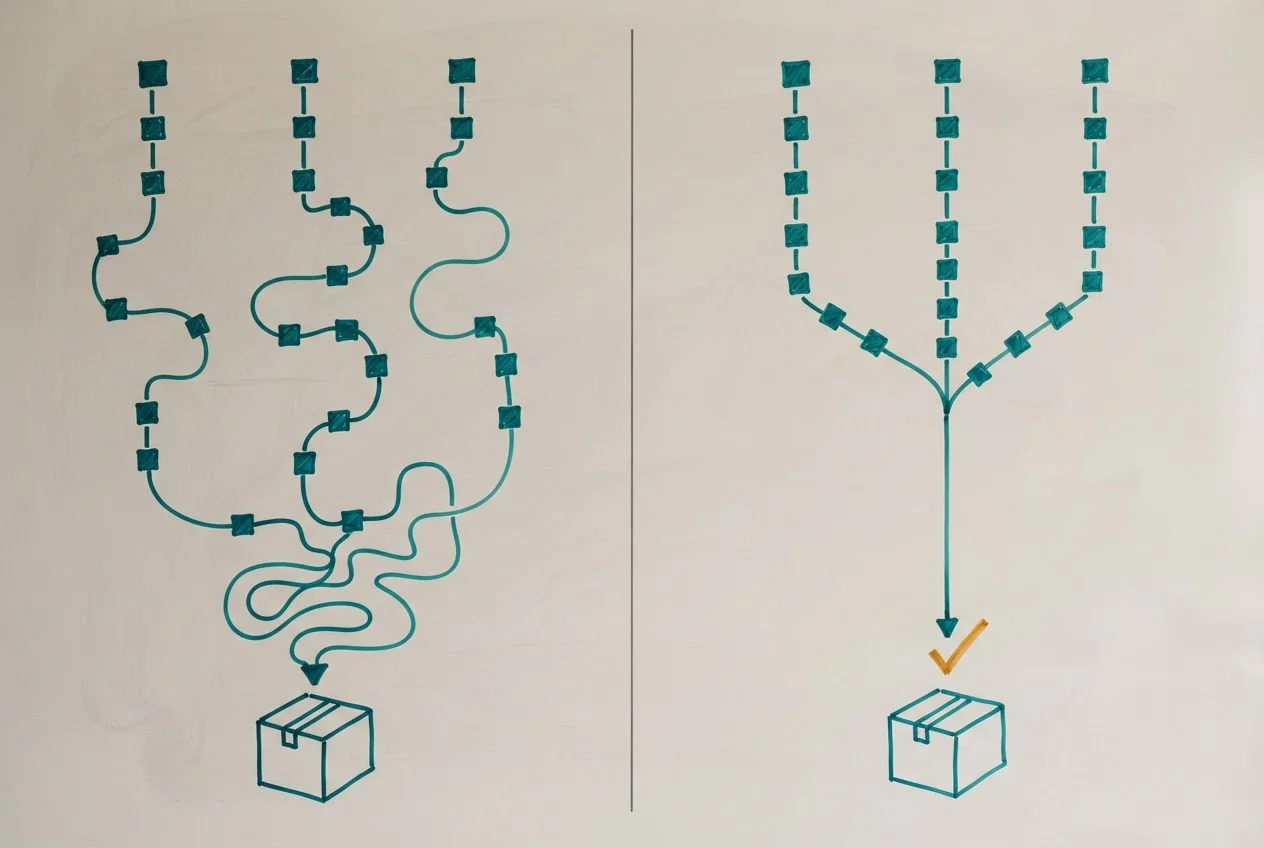
The strong answer names a benefit, a dependency and a decision.
How do you turn a project manager's answer into a program manager's answer?
Move from reporting delivery status to reporting the result the work was for. Candidates with a project manager background often describe delivery status, because project managers are measured on delivery. This is our observation, not a surveyed figure.
Here is a worked example. The numbers are invented for illustration. A program has three projects, and its target is to cut order-to-delivery time by 12%. From a 5-day baseline, that is 5 × (1 − 0.12) = 4.4 days.
Weaker answer: "All three projects were green and delivered on time."
Stronger answer: "The program target was to cut order-to-delivery time from 5 days to 4.4. All three projects reported green, but the measure had not moved. Two of them were waiting on one shared data feed. I moved the feed's owner into the program, re-sequenced both projects behind it and told the steering committee the benefit date would slip by a quarter."
The second answer holds a target, a dependency, a decision and a number. It also shows the candidate reporting bad news early, which is what the interviewer is testing.
How do you build a program manager story bank in one evening?
Write five stories, one per recurring theme: prioritisation, a failing or stopped initiative, influence without authority, a measured benefit and an escalated risk. We recommend five because each of the six questions above can be answered from one of them, and the difference-between-roles question needs none. Use these fields, which extend the common STAR format (situation, task, action, result):
| Field | What to write |
|---|---|
| Program | Name, rough ₹ budget, number of projects, duration |
| Outcome you owned | The business result, not the milestone |
| Dependency or conflict | One cross-team clash you resolved |
| Decision | Including one you stopped or deferred |
| Number | One figure the interviewer could check |
| Lesson | What you changed afterwards |
Run this pass-or-fail test on each story: can you state the benefit, one dependency, one decision and one number within 90 seconds? The 90 seconds is our rule of thumb. If any of the four is missing, the story fails and needs rewriting.
Then rehearse aloud with another person. Preparation advice from a Meta TPM on Levels.fyi makes the same point: answers that seem clear in your head often come out loose when spoken. Amazon's pages also advise STAR and metrics or data where applicable.
Finish with three questions for the interviewer:
- What measurable benefit does this program owe, and who owns it?
- How does the board decide to stop a project?
- Which projects depend on each other today?
Does a PMI credential such as PgMP or PMP change the program manager interview?
Neither of the two Amazon India postings above lists a credential from the Project Management Institute (PMI). One requires a full-time Master of Business Administration (MBA) and 3+ years of post-Master's experience. The other asks for 5+ years of cross-functional and program work, with a Master's or MBA preferred. Two postings from one employer do not show what other employers require, so check each posting's qualifications.
The Program Management Professional (PgMP) is a PMI credential for program managers. The Project Management Professional (PMP) is PMI's credential for project managers. PMI's PgMP page and its certification handbook describe the route. PgMP candidates pass a panel review of written experience summaries by external program management experts, then a 170-question multiple-choice exam of 240 minutes. Our PgMP certification process guide walks through each stage, and our PgMP and PMP comparison covers how employers weigh the two.
We have mentored or trained more than 6,000 professionals towards PgMP and the Portfolio Management Professional (PfMP) credential. If your stories keep stalling on benefits, governance or dependencies, the gap is usually vocabulary and method. Our foundation courses cover that ground: Program Leadership Blueprint is listed at US$10 and Program Management Essentials at US$99 as of October 2026, in US dollars. Program Management Essentials is a foundation course, not PgMP exam preparation. For readers heading to the credential, our PgMP Self-Paced Mentorship Program is listed at US$549. Not sure which fits? Book a free discovery consultation and we will talk through your goals and eligibility.
Frequently asked questions
Sources
- 1.Amazon: Program Manager Interview Prep
- 2.Amazon: TPM Interview Prep
- 3.LinkedIn jobs search: "program manager", India
- 4.Amazon: Sr. Program Manager, CMT (Chennai)
- 5.Amazon: Sr. Program Manager, Abuse Prevention (Bengaluru)
- 6.PMI: Program Management Professional (PgMP)
- 7.PMI: PgMP certification handbook
- 8.Levels.fyi community: Acing the Meta TPM interview
- 9.Augment Consultancy: Program Leadership foundation courses
- 10.Augment Consultancy: PgMP Self-Paced Mentorship Program