
Glossary
Program Sponsor
A program sponsor is the individual or group that provides resources and support for a program and is accountable for its success. This page defines the role and tests yours.

By Sanjeev Kumar, Founder · Updated 4 Nov 2026
On this page
- 01Definition
- 02Quick facts
- 03What a program sponsor is
- 04What a program sponsor does in practice
- 05How to test whether your program sponsor can do the job
- 06What to do if the program sponsor is absent or disengaged
- 07Program sponsor vs steering committee vs program manager
- 08Related terms for the program sponsor
- 09How Augment Consultancy handles it
- 10Example
- 11Related terms
- 12Frequently asked
What is a program sponsor?
A program sponsor is, in PMI's Standard for Program Management, an individual or group that provides resources and support for a program and is accountable for enabling its success.
Key takeaways
- The sponsor answers for benefits and the business case, and settles issues the program manager cannot settle alone.
- A sponsor who is absent or disengaged calls for a written decision route and an interim sponsor, not a workaround by the program manager.
- A program manager should test the sponsor on six points: name, authority, capacity, decision rights, response time and cover.
Quick facts
- Defined by
- PMI, The Standard for Program Management, Fifth Edition (March 2024)
- Who can hold it
- An individual or a group; a steering committee may assume the role
- Typical load (PMI 2014)
- About three projects or programs at a time, about 13 hours a week on each
- Engaged sponsors (PMI 2017)
- 62% of projects had an actively engaged executive sponsor, up from 59% in 2016
- Sponsor training
- Only 36% of organisations provided sponsor training or development (PMI 2014)
What a program sponsor is
A program sponsor is, in PMI's Standard for Program Management, Fifth Edition (March 2024), "an individual or a group that provides resources and support" and is "accountable for enabling success". The Standard adds that a steering committee may assume the role. The recommended practice is to name one executive who keeps the program supported so it can deliver its intended benefits, and who keeps the program manager informed of organisational changes that affect it.
The accountability covers governance and results. The Association for Project Management (APM) describes the sponsor as accountable for the work being governed effectively and meeting identified needs. The University of Waterloo's project office lists the working duties: validating business needs, resolving issues beyond the program manager's control, and securing senior commitment.
What a program sponsor does in practice
A sponsor settles what the program manager cannot. In this illustration, not a real engagement, a bank's chief operating officer sponsors a branch-systems migration made of three projects. The sponsor signs the program charter and sits above a steering committee of the heads of technology, finance and operations. When technology and operations disagree on a regional cutover date, the program manager brings the options, consequences and a deadline. The sponsor decides, because a cross-department conflict is beyond the manager's authority.
Engagement matters because it is far from universal. In PMI's 2017 Pulse of the Profession, 62% of projects had an actively engaged executive sponsor, up from 59% in 2016. The 2014 sponsor report cites PMI's annual survey for 63% in each of 2012, 2013 and 2014, and finds that one in three unsuccessful projects missed its goals because of poorly engaged sponsors.
How to test whether your program sponsor can do the job
Test your program sponsor on six points: name, authority, capacity, decision rights, response time and cover. Each has a pass and a fail below. The pass marks are recommended practice:
- Name. Pass: one named executive appears in the charter. Fail: the entry reads "steering committee" or "the business".
- Authority. Pass: the sponsor can approve a funding change and settle a conflict between two departments without asking anyone else. Fail: either needs a further approver.
- Capacity. In PMI's 2014 study of more than 1,000 sponsors and practitioners, run in July 2014, sponsors worked on about three projects or programs at a time, at about 13 hours a week on each, besides their regular jobs. The arithmetic: 3 projects or programs × 13 hours = 39 hours a week of sponsoring. Pass: the sponsor can name the hours per week set aside for your program and holds no more than three projects or programs (PMI's 2014 average, about 39 hours a week). Fail: no hours are set aside, or more than three.
- Decision rights. Pass: a written page states which decisions are yours, the sponsor's and the committee's. Fail: it is verbal.
- Response. Pass: a response time is agreed in writing and your last three escalations were each answered within it. Fail: no time is agreed, or any escalation was answered late or not at all.
- Cover. Pass: a named deputy decides when the sponsor is away. Fail: decisions wait.
What to do if the program sponsor is absent or disengaged
Ask for a short conversation about decision boundaries, not another report. PMI's earlier communications research, cited in its 2014 sponsor report, found 60% of executive sponsors said business benefits and strategic alignment were communicated, against 43% of project managers. So open with benefits and alignment, then make each decision obvious: the choice, the consequence and the date.
If the seat is vacant, propose an interim sponsor, such as the sponsor's own manager or the head of the benefiting department, and record the risk in writing. Do not quietly act as sponsor yourself. That leaves you accountable without the authority. Program stakeholder management covers building the relationship.
Program sponsor vs steering committee vs program manager
The sponsor owns the "why" and the authority, the steering committee governs collectively, and the program manager runs delivery. A steering committee is a group of senior stakeholders that oversees the program collectively and approves stage gates. PMI's Standard notes that a steering committee may assume the sponsor's role. The split below is a recommended division of decisions.
Who decides what: sponsor, committee, manager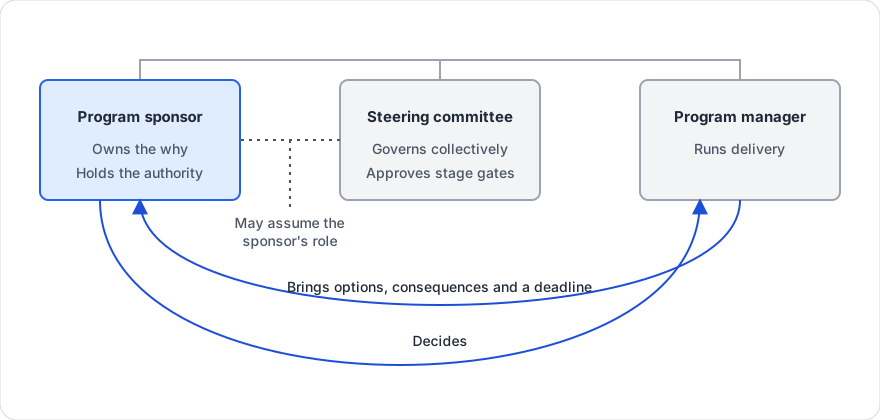
A program governance framework turns this into a decision-rights and escalation sheet. Program manager roles and responsibilities covers the manager's side.
- Aspect
- Accountable for
- Program sponsor
- Funding, support, benefits, business case
- Steering committee
- Collective oversight and approvals
- Program manager
- Day-to-day delivery across components
- Aspect
- Recommended decision rights
- Program sponsor
- Continue, change or stop the program
- Steering committee
- Approve stage gates and major changes
- Program manager
- Recommend, escalate, sequence work
How Augment Consultancy handles it
We teach program management to experienced professionals, and the sponsor relationship sits inside governance. Our Program Management Essentials course, taught by Sanjeev Kumar, covers Module 4 (Program Risk Management, which includes the PMO) and Module 7 (Program Management Principles, which includes leadership and governance). It is a foundation course, not PgMP® exam preparation, at US$99 per enrolment as of November 2026. For the certification, our PgMP® Self-Paced Mentorship Program is US$549 per enrolment as of November 2026. Our course store lists both.
If you are unsure which suits you, ask for our free discovery consultation at support@augmentconsultancy.com or +91 9816 360 116.
Example
A program charter for a bank's branch-systems migration lists "steering committee" in the sponsor line. That entry fails the Name test, because no single executive can approve a funding change or settle a technology and operations dispute over the cutover date. Naming the chief operating officer in the charter, with a deputy for absences, would pass the Name and Cover tests.
Frequently asked
Sources
- 1.The Standard for Program Management, Fifth Edition, Project Management Institute, March 2024
- 2.Executive Sponsor Engagement: Top Driver of Project and Program Success, Project Management Institute, Pulse of the Profession In-Depth Report, October 2014
- 3.Pulse of the Profession 2017: Success Rates Rise, Project Management Institute, 2017
- 4.What is project sponsorship?, Association for Project Management
- 5.Project/Program sponsor, University of Waterloo, VPAF Project Management Office