
Glossary
Project Management Office (PMO)
PMO meaning in a work setting is a project, programme or portfolio management office, the unit that sets standards and reports on the work. The same letters also name a job title.

By Sanjeev Kumar, Founder · Updated 25 Oct 2026
On this page
- 01Definition
- 02Quick facts
- 03What is the PMO meaning in project management?
- 04Why do the same three letters name an office, a person and a job?
- 05How do you tell which PMO an advert or organisation chart means?
- 06Does having a PMO improve results?
- 07Which terms sit next to PMO, and which credentials appear?
- 08How Augment Consultancy handles it
- 09Example
- 10Related terms
- 11Frequently asked
What does PMO mean in project management?
A Project Management Office (PMO) is an organisational unit that supports work at project, programme or portfolio level by setting process standards and reporting on that work. The Association for Project Management (APM) defines it.
Key takeaways
- In India the same letters also name a seat: job titles run from analyst to head, and most descriptions do not spell out the office.
- Read the first letter, the verbs in the advert and the credentials it lists to tell whether a PMO supports projects, programmes or the portfolio.
- Having a PMO is associated with better-managed complexity, but the gap is modest and self-reported.
Quick facts
- Defined by
- Association for Project Management (APM)
- Levels it can support
- Project, programme or portfolio
- As a job title
- Project Management Officer, a person rather than a department
Type PMO into a job board and the results mix analysts, officers and heads of department under the same three letters. Many adverts never spell out what the letters stand for.
That is why a plain definition is not enough. A PMO is a unit with a mandate, and the mandate changes with the first letter: project, programme or portfolio. A project office supports individual projects, a programme office supports several linked projects, and a portfolio office supports selecting and funding work. A seat in it can mean compiling status reports or preparing the case for which investments a board should fund.
This page gives the definition from the Association for Project Management (APM), shows how Indian employers use the term in a review of job postings, and gives you a table for reading any advert or organisation chart. The slang and government meanings get a line each, so you can rule them out and move on.
What is the PMO meaning in project management?
In project management, PMO stands for project, programme or portfolio management office. APM defines it as "an organisational structure that provides support to projects", and the first letter changes with the level it supports: project, programme or portfolio (APM, What is a PMO?).
The unit typically sets process standards and reports on the work it supports, and its exact form depends on the organisation.
Two other meanings are not work terms. On social media, PMO is slang for "put me on" or "pisses me off" (Know Your Meme). In Indian news it is the Prime Minister's Office.
Why do the same three letters name an office, a person and a job?
The letters name an office, a person and a seat because employers use PMO as shorthand for all three. A LinkedIn jobs search for PMO in India on 25 October 2026 returned 280 unique postings. Of these, the 90 with a PMO term in the title were kept and each description was read. Title levels were assigned by keywords in the title (for example director, head, VP or chief for the top band; manager; analyst, associate, coordinator or officer for the bottom band). Mentions of reporting, governance, risk, portfolio or credentials are keyword matches in the description text. This is one platform on one day, so treat it as a sample, not a market count.
- Seven titles say "Project Management Officer", a person, and one says "Project Management Operations".
- Only 26 descriptions spell out an office: 18 say project management office and 8 say programme management office. None says portfolio management office.
- The other 64 do not spell out an office.
- Title level
- Analyst, coordinator, associate or officer
- Postings
- 22
- Title level
- Senior analyst, specialist or consultant
- Postings
- 13
- Title level
- Manager
- Postings
- 17
- Title level
- Lead or senior manager
- Postings
- 14
- Title level
- Director, head, VP, deputy general manager or chief
- Postings
- 9
- Title level
- Bare "PMO" or other
- Postings
- 15
How do you tell which PMO an advert or organisation chart means?
Read the first letter, then the verbs, then the credentials. The reading guide below is an inference from the 90 postings and the APM definition of a PMO; the rows are judgement, not counted results.
Reading the first letter of PMO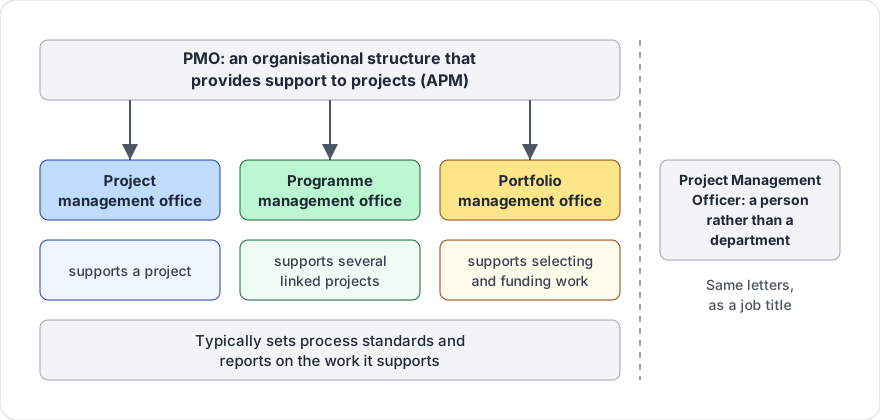
Across the 90 postings, 81 mention reporting or dashboards, 73 governance, 70 risk and 48 portfolio. Inference: if reporting is the only verb, the seat prepares information. If prioritising, approving or escalating appear, it supports decisions.
That is an analyst seat asking for portfolio-level knowledge.
For how decisions and escalation run, see Program Governance Framework.
- Clue
- "Project Management Officer" in the title
- Likely meaning
- A person, not a department
- Test
- Pass: the advert describes one individual's duties
- Clue
- "Programme Management Office"
- Likely meaning
- An office serving related projects for shared benefits
- Test
- Pass: it mentions benefits, stage gates or programme governance
- Clue
- Portfolio language and a senior title
- Likely meaning
- An office feeding prioritisation and funding
- Test
- Pass: it mentions selecting or ranking work, not only tracking it
- Clue
- Bare "PMO" in an IT or consulting advert
- Likely meaning
- A project office seat
- Test
- Pass: the duties are reporting, governance and tools
- Clue
- Tools only (Jira, Microsoft Project, Planview, Smartsheet)
- Likely meaning
- Administration-led seat
- Test
- Fail as a decision seat: no mention of prioritising or approving
Does having a PMO improve results?
Having a PMO is associated with better-managed complexity, but the difference is modest and self-reported. The Project Management Institute (PMI) surveyed 2,023 project professionals and 511 senior leaders in 35 countries for its Pulse of the Profession 2026. Those in organisations with a PMO were more likely to say they managed the complexity of their projects "very or extremely" successfully (63% against 57%) (PMI, Pulse of the Profession 2026).
The survey does not show that a PMO causes the gap. A better test of an employer's PMO is what it decides and funds, not whether it exists.
How Augment Consultancy handles it
Program Management Essentials has a Program Management Office topic within Module 4 (Program Risk Management). The course runs 12 weeks across 10 modules and costs US$99 as of October 2026. To check which of our programmes suits your seat, ask for a free discovery consultation at support@augmentconsultancy.com or +91 9816 360 116.
Example
An advert titled "PMO Analyst" lists weekly status dashboards, risk logs and Jira administration, and never mentions ranking or approving work. Using the reading guide, it is a project office seat that prepares information for others to decide on, not a portfolio seat.