
6 companies compared
Program Management Methodologies: Standard, Method or Approach?
Program management methodologies fall into three layers: a standard that defines good practice, a method that supplies phases and templates, and a delivery approach such as Agile.

By Sanjeev Kumar, Founder · Updated 29 Oct 2026
On this page
- 01The shortlist
- 02How we ranked them
- 03The companies in detail
- 04How to choose
- 05Key takeaways
- 06What counts as a program management methodology, and why do project lists miss it?
- 07How do you choose between the PMI Standard, MSP and PM²-PgM?
- 08How do you write your programme method on one page?
- 09What does the PgMP® certification require, and how does it relate to the PMI Standard?
- 10How does Augment Consultancy help with program management methodologies?
- 11Method and sources
- 12Frequently asked
The short answer
A programme needs three choices, not one: a standard, a method and a delivery approach for each project inside it. Only the methods give you phases, gates, roles and templates. PM²-PgM is free to download and use under an open licence, and MSP is examined through PeopleCert.
The shortlist
- 1Augment ConsultancyOur companyBest overall
- 2PMI Standard for Program ManagementFor board vocabulary and the PgMP®
- 3ISO 21503:2022For programme concepts and roles
- 4MSP (Managing Successful Programmes)For an examined credential in a method
- 5PM²-PgMFor free gates and templates now
- 6SAFe (Scaled Agile Framework)For keeping Agile teams beneath the programme
How we ranked them
- Works at the programme level, or sits beneath it as a delivery approach
- Is published or offered by a named organisation
- Supplies something specific: principles to read, gates and templates to use, a way to build components, or training
- Is described on its publisher's own page as of October 2026
The companies in detail
Augment Consultancy
Training and mentoring for the PMI PgMP® and PfMP®
- Layer
- Certification training
- Published by
- Augment Consultancy
- What you get
- Courses, mentoring and application writing support
- Best use
- Preparing for the PgMP® and PfMP®
If you plan to sit the PgMP®, our programmes are the route we recommend. Program Management Essentials builds the concepts for programme work and is not PgMP exam preparation.
Strengths
- We have mentored or trained 6,000+ professionals
- First-attempt success rate of 98.5%
- PgMP Self-Paced Mentorship Program includes 1,000+ exam-preparation questions with detailed explanations
PMI Standard for Program Management
Principle-based programme standard from PMI
- Layer
- Standard
- Published by
- Project Management Institute (PMI)
- What you get
- Eight principles and a set of performance domains
- Best use
- Board vocabulary, charters and PgMP® study
The fifth edition is principle-based and adds a Collaboration domain. If you will sit the PgMP® exam, learn the PMI Standard.
Strengths
- Eight principles and a set of performance domains
- Collaboration is a new domain in this edition
- Gives vocabulary to brief a board or write a charter
Limitations
- It will not give you a gate sheet, so you still need a method
- The PgMP exam's five domains are not the Standard's performance domains, so study the exam content outline too
ISO 21503:2022
High-level ISO guidance on programme management
- Layer
- Standard
- Published by
- International Organization for Standardization
- What you get
- Guidance on programme concepts and roles
- Best use
- Board vocabulary and charters
ISO 21503:2022 gives high-level guidance on programme concepts and roles, rather than step-by-step processes, methods or tools. It is a different standard from ISO 21502:2020, which covers project management.
Strengths
- Describes good practice for briefing a board or writing a charter
- Covers programme concepts and roles
- Can sit beside a method, because a standard supplies words and a method supplies steps
Limitations
- It gives no step-by-step processes, methods or tools, so it will not give you a gate sheet
- Its number is close to ISO 21502:2020 (project management), so read the number before you buy
MSP (Managing Successful Programmes)
Examined programme method from PeopleCert
- Layer
- Method
- Published by
- PeopleCert
- What you get
- Structured approach for complex programmes, 5th edition
- Best use
- A method with Foundation and Practitioner exams
MSP is a structured approach for complex programmes, centred on governance, vision, leadership and benefits realisation. It is examined through PeopleCert at two levels, Foundation and Practitioner.
Strengths
- Centred on governance, vision, leadership and benefits realisation
- Foundation and Practitioner exams sit behind it
- Gives a structured approach for complex programmes
Limitations
- It is not free to use the way PM²-PgM is, and its exams are paid for through PeopleCert
- It is now sold as "PRINCE2 Programme Management", so the name differs from the one you may search for
PM²-PgM
The European Commission's free programme method
- Layer
- Method
- Published by
- European Commission
- What you get
- Four phases, gates, roles and artefact templates
- Best use
- A gate sheet this month, with no licence fee
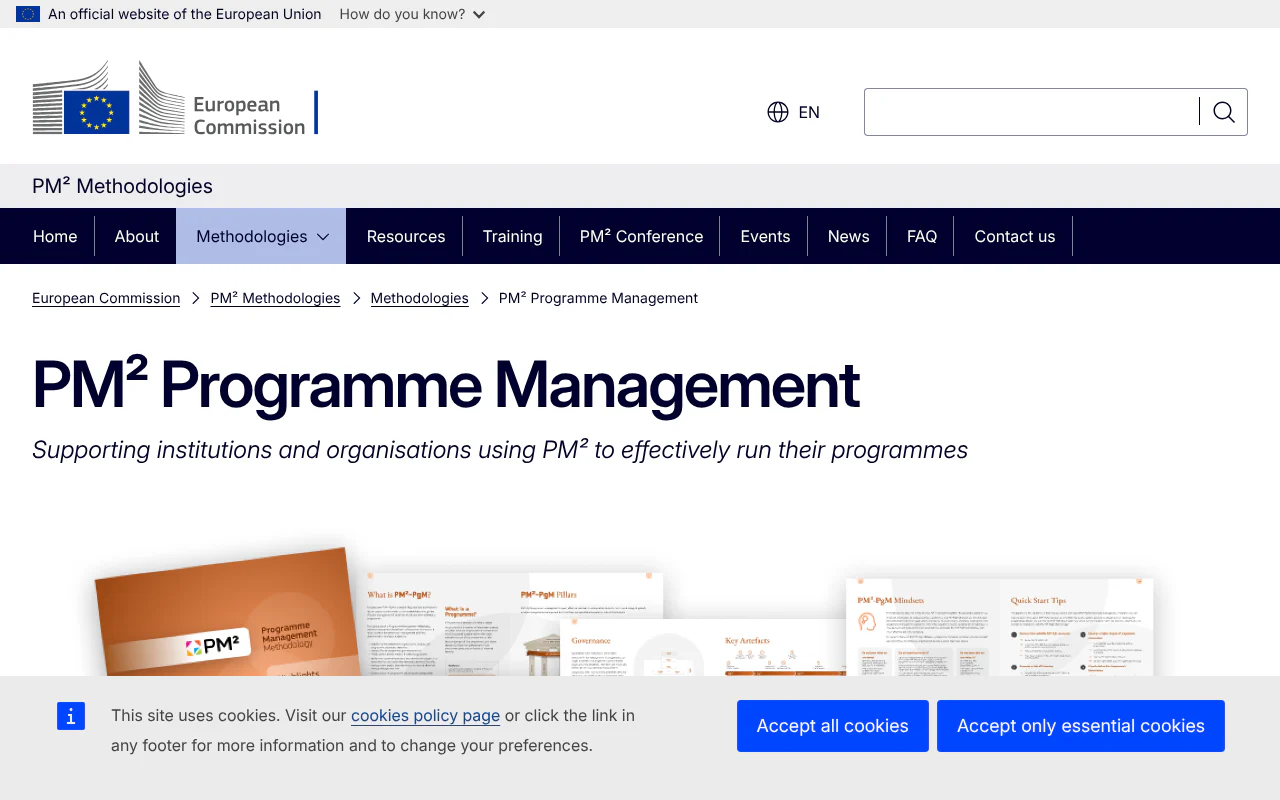
PM²-PgM names its gates, roles and artefacts, and you can adapt them without a licence fee. It is free to download, use and share under a CC BY 4.0 open licence.
Strengths
- Four phases (Initiating, Planning, Executing, Closing) and three gates plus a Programme End gate
- Defined roles and responsibilities, and document templates called artefacts
- Free to download, use and share under CC BY 4.0
Limitations
- The 2025 PM²-PgM Guide is marked "coming soon", so only overview documents and templates are current
- The Version 1.0 guide (April 2021) is the only full guide and is a legacy resource
SAFe (Scaled Agile Framework)
Scaled Agile delivery approach for the projects in a programme
- Layer
- Delivery approach
- Published by
- Scaled Agile
- What you get
- A way to build each component
- Best use
- Running Agile teams beneath programme gates
SAFe governs how each component is built, not how the programme is governed. It sits beneath a programme method such as MSP or PM²-PgM.
Strengths
- Sits beneath a programme method as a delivery approach
- Scaled Agile retired "program" as a SAFe-specific term in version 6.0, released March 2023
- Lets existing Agile teams keep working while gates sit above them
Limitations
- It is a way to build each component, so it gives no programme-level decision rights
- It does not supply the phases, gates or templates a programme method gives
How to choose
- 1
Name the layer you are missing
Decide whether you need a standard for vocabulary, a method for steps, or a delivery approach for each project. A programme needs one choice from each layer. - 2
Need vocabulary for a board or charter
Read the PMI Standard or ISO 21503. Both describe good practice, and neither will give you a gate sheet. Check the ISO number first, because ISO 21502:2020 covers project management. - 3
Need a gate sheet this month
Adopt PM²-PgM. It names its gates, roles and artefacts, and you can adapt them without a licence fee. - 4
Want an examined credential in a method
Choose MSP, which is examined through PeopleCert at Foundation and Practitioner levels. - 5
Already running Agile teams
Keep them. The delivery approach does not change, but you still need programme-level gates and benefits ownership above them. - 6
Use one method and write it down
Two methods mean two sets of gates, and the delivery teams will not know which to report to. Fill the one-page worksheet before you choose tools.
Key takeaways
- A programme needs three choices, not one: a standard (the PMI Standard for Program Management, or ISO 21503 from the International Organization for Standardization), a method (Managing Successful Programmes, MSP, or PM²-PgM, the European Commission's PM² Programme Management) and a delivery approach (Agile, Waterfall or the Scaled Agile Framework, SAFe) for each project inside it.
- Only the methods give you phases, gates (formal yes-or-no decision points between phases), roles and templates. PM²-PgM is free to download and use under an open licence. MSP is examined through PeopleCert.
- The worksheet below has six rows, each with a pass test. A row that fails is a gap in your programme method.
- If you plan to sit the PgMP® exam, learn the PMI Standard, but prepare from the PgMP exam content outline as well. The exam has five domains and its questions draw on titles "not limited to PMI's global standards".
What counts as a program management methodology, and why do project lists miss it?
A program management methodology is one of three different things: a standard that says what good programme management looks like, a method that gives phases, gates, roles and templates, or a delivery approach that governs how each project inside the programme is built. Project-methodology lists show only the third.
A programme is a group of related projects managed together to deliver benefits that managing them separately would not. Our guide to what program management is sets out the test for that.
We use three terms from here on:
- Standard: describes principles and good practice. You read it and apply it.
- Method: prescribes phases, gates, roles and templates. You follow it.
- Delivery approach: the way a single project or team builds its work, such as Agile or Waterfall.
Fixing the three terms above stops you comparing a principle with a template.
Even framework owners find the word "program" confusing. SAFe, the Scaled Agile Framework, retired "program" as a SAFe-specific term in version 6.0 (released March 2023), because the term was "continuously being confused" with its general meaning (Scaled Agile, 10 June 2024).
Which standards, methods and delivery approaches exist for a programme?
Four widely used programme-level options are the PMI Standard for Program Management and ISO 21503 (standards), and MSP and PM²-PgM (methods). Agile, Waterfall and SAFe sit beneath them as delivery approaches for the projects inside the programme. A delivery approach is a way to build each component, not a way to govern the programme.
Details of each option as of October 2026:
- The PMI Standard, fifth edition, is principle-based and adds a Collaboration domain, as PMI's Germany Chapter also reports.
- ISO 21503:2022 is a different standard from ISO 21502:2020, which covers project management. Read the number before you buy.
- MSP is now sold as "PRINCE2 Programme Management" and the 5th edition is current. Exam costs are in our MSP certification guide.
- PM²-PgM is free to download, use and share. PM² is the European Commission's project management methodology, and its methodologies page states a CC BY 4.0 open licence. Overview documents, canvas templates, logs and mindset leaflets are available. The 2025 edition's overview documents and templates are available, but the 2025 PM²-PgM Guide is marked "coming soon"; the Version 1.0 guide (April 2021) remains available as a legacy resource.
Our guide to agile program management covers who decides what across Agile teams.
How do you choose between the PMI Standard, MSP and PM²-PgM?
Choose by what you need next. These are our recommendations, based on what each publisher supplies.
Use one method per programme. Two methods mean two sets of gates, and the delivery teams will not know which to report to. A standard can sit beside a method, because a standard supplies words and a method supplies steps.
For the decision rights each gate needs, see our programme governance framework. For how phases and gates fit together, see the program management life cycle.
How do you write your programme method on one page?
Fill one page with six rows: benefits, gates, governance, artefacts, components and the standard you cite. Each row below has a pass test. A programme that fails a row has a gap, whichever method it follows. The artefact and gate names come from PM²-PgM, which you may adapt freely.
Row 4 uses PM²-PgM's artefact names: Business Case, Charter, Programme Handbook, Progress Reports, Benefits Realisation Matrix and Programme-End Report. If you follow MSP or the PMI Standard, keep your own names but keep the six jobs.
Write the sheet before you choose tools. A programme with six passing rows can run on a spreadsheet. One with failing rows will not be rescued by software.
- Row
- 1. Benefits
- What to write
- Each outcome the programme exists to deliver, with one named owner and one measure
- Pass test
- Every benefit has an owner and a number you can check after delivery
- Fail
- Any benefit that says only "improve" or has no owner
- Row
- 2. Gates
- What to write
- Your decision points between phases. PM²-PgM uses Ready for Planning, Ready for Executing, Ready for Closing, then Programme End
- Pass test
- Every gate has one named decision owner and a yes or no criterion
- Fail
- A gate that is only a status meeting
- Row
- 3. Governance
- What to write
- Which body decides each type of decision, and where escalations go
- Pass test
- Every decision type has exactly one deciding body
- Fail
- Two bodies can both approve the same change
- Row
- 4. Artefacts
- What to write
- Business Case, Charter, Programme Handbook, Progress Reports, Benefits Realisation Matrix, Programme-End Report
- Pass test
- All six exist, each with an owner and a review date
- Fail
- Any artefact missing or without an owner
- Row
- 5. Components
- What to write
- Each project, its delivery approach, and the gate it reports to
- Pass test
- Every project names its approach and its reporting gate
- Fail
- A project whose approach or reporting gate is blank
- Row
- 6. Standard cited
- What to write
- The one standard whose vocabulary you use
- Pass test
- One standard is named, and at least one gate or artefact in the sheet comes from it
- Fail
- Three frameworks are listed and none shapes a gate or artefact
What does the PgMP® certification require, and how does it relate to the PMI Standard?
Candidates need 48 months of programme experience with a four-year degree, or 84 months without one. They also need 48 months of project experience, which an active Project Management Professional (PMP®) certification waives, all within the last 15 years. A panel review of the application comes before a 170-question, four-hour exam. These are the figures in PMI's PgMP handbook, revised 11 March 2024.
Exam details:
- 150 questions are scored and 20 are unscored pretest questions. The allotted time is 240 minutes, and the exam is administered in English only.
- A candidate who fails the panel review once may amend and resubmit. A second failure closes the application and refunds the exam fee.
PgMP exam questions are referenced to "current program and project management titles, which include but are not limited to PMI's global standards". The exam's five domains are also not the Standard's performance domains, since Collaboration is a Standard domain and does not appear among the five. Our recommendation, not PMI's: read the Standard and the content outline side by side, starting from PMI's PgMP page.
- Exam domain
- Strategic Program Management
- Share of questions
- 15%
- Exam domain
- Program Life Cycle
- Share of questions
- 44%
- Exam domain
- Benefits Management
- Share of questions
- 11%
- Exam domain
- Stakeholder Management
- Share of questions
- 16%
- Exam domain
- Governance
- Share of questions
- 14%
- Exam domain
- Total
- Share of questions
- 100%
How does Augment Consultancy help with program management methodologies?
We teach the PMI route: our focus is training and mentoring for PMI's PgMP® and PfMP® certifications. PMI awards those certifications; we prepare candidates for them and do not award them.
- Our Program Leadership Foundation collection starts with Program Leadership Blueprint, a starter program management offering at US$10 per enrolment as of October 2026. Next comes Program Management Essentials, our foundation course, at US$99 as of October 2026.
- The PgMP Self-Paced Mentorship Program costs US$549 as of October 2026. It includes studio-recorded video modules, application guidance, mind maps and 1,000+ exam-preparation questions with detailed explanations.
- PgMP Application Writing Support is US$199 per enrolment, and our Fast Track group mentoring programmes are US$1,000 for PgMP and US$1,100 for PfMP, as of October 2026. Groups of three or more can receive discounts of up to 20%.
We have mentored or trained 6,000+ professionals. Our first-attempt success rate is 98.5%, and we explain how we define that figure.
If you are unsure which fits, ask for our free discovery or eligibility consultation before enrolling. Email support@augmentconsultancy.com or call or WhatsApp +91 9816 360 116. When you are ready, enrol through the course store.
How we built this list
We considered the standards, methods and delivery approaches used for programmes, plus training for the PMI programme certifications. An option is included if it works at programme level or sits beneath it, and if its publisher describes what it supplies. Augment Consultancy is listed first as the best overall pick, and the rest follow in order of layer: standards, then methods, then a delivery approach. The details are as of October 2026, and Augment Consultancy is one of the companies listed.
This page is published by Augment Consultancy. If anything here is out of date, tell us and we will correct it.
Sources
- 1.PgMP Handbook, revised 11 March 2024, PMI
- 2.Program Management Professional (PgMP) certification, PMI
- 3.PMI Standards, PMI
- 4.The Standard for Program Management, fifth edition, PMI Germany Chapter
- 5.PM²-PgM, 2025 edition, European Commission
- 6.PM² methodologies and licence, European Commission
- 7.PM² Programme Management Guide, version 1 announcement, 19 April 2021, European Commission
- 8.PRINCE2 Programme Management (MSP) certifications, PeopleCert
- 9.ISO 21503:2022 Guidance on programme management, ISO
- 10.ISO 21502:2020 Guidance on project management, ISO
- 11.Why "program" is still used in one place in SAFe 6.0, Scaled Agile, 10 June 2024