
Glossary
Program Communication Plan
A program communication plan sets out who receives which programme information, from whom, how often and through which channel, adding a roll-up of project reporting.

By Sanjeev Kumar, Founder · Updated 5 Nov 2026
Also called Programme communication plan
On this page
- 01Definition
- 02Quick facts
- 03Key takeaways
- 04What is a program communication plan?
- 05How does a program communication plan differ from a project communication plan?
- 06What does a program communication plan look like in practice?
- 07Why do program communication plans fail?
- 08What is a program communication plan often confused with?
- 09How Augment Consultancy handles it
- 10Example
- 11Related terms
- 12Frequently asked
What is a program communication plan?
A program communication plan fixes who needs which programme information, when, through which channel and from whom, across all the projects in a programme.
Key takeaways
- Add four things to a project plan: roll-up, one sender, benefit messages, outside approval.
- Review the plan on a set date, because it describes the programme as it is now.
- Give every audience that would otherwise hear from a project manager its own row.
- Ask each audience after a quarter whether the messages were useful.
Quick facts
- Also known as
- Programme communication plan (British spelling)
- Part of
- A sub-plan of the programme management plan
- Who writes it
- The programme manager, agreed with the sponsor
- Standard reference
- PMI, The Standard for Program Management, Fifth Edition (April 2024), section 4.3.6
- Review
- A living document, kept current through the programme
Three projects each report to their own audience in their own format, and the sponsor receives three versions of the truth.
Take a bank's digital onboarding programme with an app build, a customer-verification integration and branch staff training. The app project quotes one launch date and the integration project quotes another. Branch staff are told a third date in their briefing pack. Two project managers brief the same executive with different numbers, and nobody owns the message that spans the projects.
A communication plan written for one project cannot fix this. It lists audience, message, channel, frequency and owner for a single piece of work.
Key takeaways
- A programme communication plan is a project plan plus four things: a roll-up rule, one sender per audience, benefit messages next to delivery messages, and an approval route for outside parties.
- Write it at the start of the programme and keep it current. The plan is a living document, not a one-off deliverable.
- Copying a project template across all your projects gives you three plans and no programme message.
- Fix one roll-up day for all project reports, for example Tuesday 12:00 for inputs and Thursday for the programme report, and hold it.
What is a program communication plan?
It is one of the sub-plans of the programme management plan; for how the sub-plans fit together, see Program Management Plan: Structure, Sub-Plans and Decision Rights. The Project Management Institute (PMI)'s The Standard for Program Management, Fifth Edition (April 2024) covers program communications management in section 4.3.6.
In practice the programme manager writes it and the sponsor agrees it. The University of Waterloo's project management office calls it a "living document" written by the project or program manager and agreed with the sponsor and project owner (University of Waterloo). The programme sponsor is usually the first name on your audience list.
How does a program communication plan differ from a project communication plan?
A programme communication plan differs in four ways: it fixes a roll-up rule for project reporting, names one sender for each audience, carries benefit messages as well as delivery messages, and routes anything external through one approver.
A project plan plus four programme additions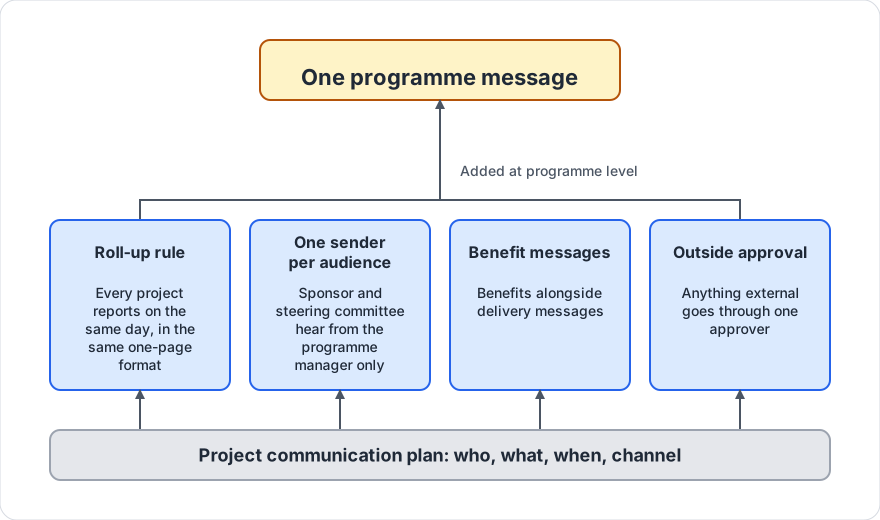
- A roll-up rule. Every project reports on the same day, in the same one-page format, so the programme report can be built from them without re-interpretation.
- One sender per audience. The sponsor and steering committee hear from the programme manager only. Project managers do not send their own versions upward.
- Benefit messages. The sponsor needs to know whether the intended benefits are still reachable, not only whether each project is on track. See Program Change Management for who carries adoption messages before handover.
- An approval route for outsiders. Regulators, partners and the public hear one message, approved once, by one named approver.
The World Bank's guidance for its umbrella programmes says the communication plan should be started at design stage and maintained throughout the programme's life (World Bank, March 2020, section 2.0). The timing applies to any programme; the note's visibility and branding rules are specific to donor-funded ones.
What does a program communication plan look like in practice?
A programme communication plan can be one table. Here is an illustrative example for a bank's digital onboarding programme with three projects: an app build, a customer-verification integration and branch staff training. The rows and timings are illustrative, not a standard. Red, amber or green (RAG) status shows whether a project is on track, at risk or off track, and a gate is a formal go or no-go review at the end of a programme stage.
The roll-up rule that makes it work: project managers submit the one-page report by Tuesday 12:00 each week; the programme manager issues the weekly programme report by Thursday. Pick your own days, but fix them and hold them. A programme report built from late or differently formatted inputs is the usual way the plan stops being followed.
To reuse the table, copy the six column headings. Then add one row for every audience that would otherwise hear from a project manager directly.
- Audience
- Sponsor
- Purpose
- Decide
- Message
- Status, benefit forecast, decisions needed
- Channel and frequency
- Monthly sponsor pack built from the weekly roll-up; call within 2 working days of a red item
- Sender
- Programme manager (approver: programme manager)
- Audience
- Project managers
- Purpose
- Align
- Message
- Cross-project dependencies, changed dates
- Channel and frequency
- 30-minute call weekly
- Sender
- Programme manager (approver: programme manager)
- Audience
- Branch staff
- Purpose
- Inform and consult
- Message
- What changes for them, and when
- Channel and frequency
- Briefing pack before each release
- Sender
- Training project manager (approver: programme manager)
- Audience
- Regulator, external partner
- Purpose
- Inform
- Message
- Dates and commitments
- Channel and frequency
- Formal letter at each gate
- Sender
- Sponsor (approver: programme manager)
Why do program communication plans fail?
Programme communication plans fail mainly because they are copied from a single-project template, written once and never reviewed. The causes are usually the same few:
- One version for every audience. The sponsor needs decisions and benefits; delivery teams need dates and blockers.
- No named sender. Two project managers brief the same executive with different numbers.
- No review date. The plan describes the programme as it was at kick-off.
- No test of whether it worked. Ask each audience, after a quarter, whether the messages they received were useful.
Why bother? PMI's 2013 Pulse of the Profession study found that highly effective communicators met original goals in 80% of projects against 52% for minimally effective ones, delivered on time in 71% against 37%, and within budget in 76% against 48%. The study covered 742 practitioners, 148 executive sponsors and 203 business owners, interviewed in March 2013 (see note 1 in the References of PMI, December 2013). High performers were also nearly twice as likely to use formal communication plans (the paper's "Plan of Action" section).
Treat that as dated evidence about projects, not programmes. The gap is likely at least as wide in programmes, because more teams mean more hand-offs.
What is a program communication plan often confused with?
The programme communication plan is most often confused with the stakeholder register, a communication strategy and the escalation path.
- Stakeholder register: the list of who is affected and how much influence they hold. The plan draws on it. For the register itself, see Program Stakeholder Management.
- Communication strategy: the "why" and the intended outcome. The Association for Project Management (APM) puts it this way: "a plan is a collection of tactics with timings that are designed to deliver the strategy" (APM, August 2020).
- Escalation path: who decides when something goes wrong. The plan points to it; Program Governance Framework sets it out.
How Augment Consultancy handles it
We teach the programme stakeholder work that a communication plan rests on. Program Management Essentials (US$99 per enrolment, as of November 2026) has 10 modules, including Module 5 on programme stakeholder engagement and Module 8 on programme collaboration, with ready-to-use templates and programme artifacts. It is a foundation course, not exam preparation for the Program Management Professional (PgMP®) certification. Program Leadership Blueprint (US$10 per enrolment) is the starter option for project managers moving into programmes; its Module 3 covers stakeholders, leadership and critical skills.
If you are unsure which suits you, ask for our free discovery consultation at support@augmentconsultancy.com or on +91 9816 360 116 (phone or WhatsApp); the details are on Augment support and contact.
Example
In the bank's onboarding programme, the app project's one-page report reaches the programme manager by Tuesday 12:00 with one launch date, while the integration project's report carries another. The programme manager reconciles the two before the Thursday programme report, so the sponsor and the branch staff briefing pack receive a single date from a single sender.
Frequently asked
Sources
- 1.PMI, "Communication: The Message Is Clear" (December 2013), citing the Pulse of the Profession in-depth report, May 2013
- 2.World Bank, Communication and Visibility in Umbrella Programs (revised March 2020)
- 3.APM, Communication planning (August 2020)
- 4.University of Waterloo, VPAF Project Management Office, Communications Plan
- 5.PMI, The Standard for Program Management, Fifth Edition (April 2024)