
Glossary
Portfolio Resource Management (PRM)
Portfolio resource management (PRM) is how an organisation plans, allocates and balances its limited people, budget, tools and equipment across competing initiatives to support its strategic priorities.

By Sanjeev Kumar, Founder · Updated 29 Oct 2026
Also called PRM
On this page
- 01Definition
- 02What is portfolio resource management?
- 03How does resource management at portfolio level differ from project level?
- 04How do you calculate real capacity and demand?
- 05What does a worked example of an oversubscribed skill look like?
- 06Which constraint should you resolve first?
- 07Who decides what to defer or stop?
- 08What can you do when the portfolio does not fit?
- 09Where does PRM sit in PMI's Standard for Portfolio Management?
- 10How Augment Consultancy handles PfMP® preparation
- 11Example
- 12Related terms
- 13Frequently asked
What is portfolio resource management?
Portfolio resource management (PRM) is the sharing of one limited pool among all the programmes and projects an organisation runs together, which is its portfolio.
Key takeaways
- Resolve the scarcest skill first: the skill with the highest demand ÷ capacity ratio above 1.0 limits how much of the portfolio can move.
- Real capacity is what remains after leave, run-the-business work (routine operations and support that keep current services running) and unplanned requests. In the worked illustration, 84 gross person-days become 54.
- A demand ÷ capacity ratio above 1.0 for one skill means work must be deferred, descoped, resequenced or stopped, or capacity added. A portfolio board decides which.
- Test scenarios before deciding. Unplanned requests are already deducted from real capacity, so that deduction is the buffer.
A portfolio can be ranked perfectly and still be undeliverable. Five approved initiatives may all need the same four data architects in the same month, and the ranking says nothing about who gets them.
In practice, that is where portfolio resource management usually fails. Ranking shows what matters most. It does not show how much work people can absorb, which skill runs out first, or who has the authority to make something wait. The result is a plan that balances on paper and breaks in week three.
The sections below give the working definition, four terms that are often confused, a worked table in person-days, and a decision rule for the moment demand still exceeds capacity. The numbers in the worked table are invented for illustration.
The problem starts after the ranking is done, when the honest answer to whether all of it can be done this quarter is no.
What is portfolio resource management?
It is the sharing of one limited pool among all the programmes and projects an organisation runs together, which is its portfolio. Resources means people, budget, tools and equipment, not only people, and any of them can be the pool that initiatives compete for.
From 84 gross days to 54 real days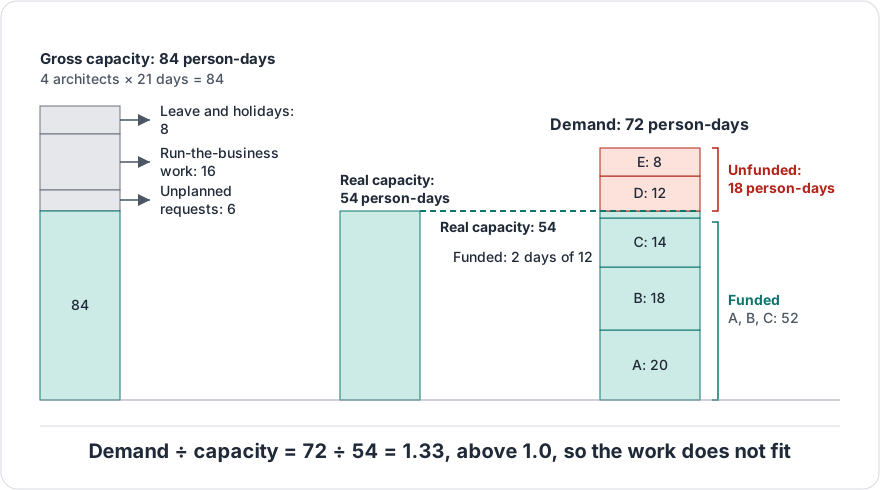 ### Why does ranking alone not make a portfolio deliverable?
A portfolio can be ranked perfectly and still be undeliverable. Five approved initiatives may all need the same four data architects in the same month, and the ranking says nothing about who gets them.
In practice, that is where portfolio resource management usually fails. Ranking shows what matters most. It does not show how much work people can absorb, which skill runs out first, or who has the authority to make something wait. The result is a plan that balances on paper and breaks in week three.
The problem starts after the ranking is done, when the honest answer to whether all of it can be done this quarter is no.
The sections below explain four terms that are often confused, give a worked table in person-days, and set out a decision rule for the moment demand still exceeds capacity. The numbers in the worked table are invented for illustration.
How do capacity, capability, demand and allocation differ?
Capacity is how much work the organisation can absorb in a period. Capability is what it can do, skill by skill. Demand is the work requested of it. Allocation is the decision to assign named people or money to initiatives. These are working definitions for this page, not wording from the Project Management Institute (PMI).
The distinction decides the fix. A capacity gap is closed by adding people or removing work. A capability gap is closed by training or hiring: ten free generalists do not replace one unavailable specialist.
How does resource management at portfolio level differ from project level?
Project-level resource management staffs one project so that it delivers. Portfolio resource management shares one pool across every project competing for it. For the programme-versus-portfolio distinction, see programme vs portfolio management.
- Aspect
- Scope
- Project level
- One project's team
- Portfolio level
- All initiatives drawing on the same pool
- Aspect
- Who decides
- Project level
- Project manager
- Portfolio level
- Portfolio board, with the Project Management Office (PMO) reporting capacity
- Aspect
- What is optimised
- Project level
- That project's delivery
- Portfolio level
- Total portfolio value within capacity
How do you calculate real capacity and demand?
Real capacity is gross working days minus leave and holidays, run-the-business work and unplanned requests, counted per skill and per month. Demand is the work of the approved initiatives on that skill. Deduct run-the-business work and unplanned requests from capacity, not from demand, so they are never counted twice.
In practice, unlogged requests are a common cause of broken plans. Ask each specialist to list last month's and size the deduction from them.
What does a worked example of an oversubscribed skill look like?
In this illustration, one scarce skill has 54 person-days of real capacity against 72 person-days of ranked demand, a demand ÷ capacity ratio of 1.33. All numbers are invented.
The model: four enterprise data architects, one month of 21 working days. Gross capacity is 4 × 21 = 84 person-days. Less 8 for leave and holidays, 16 for run-the-business work and 6 for unplanned requests, real capacity is 54. Demand by rank is A 20, B 18, C 14, D 12 and E 8, a total of 72. Funding by rank covers A, B and C (52), leaves 2 days for D and none for E, so 18 days are unfunded.
The scenarios use five options, defined once here:
- Defer: push an initiative out of this period without a new date.
- Resequence: keep it but give it a fixed later slot, because others depend on it or capacity returns then.
- Descope: cut its scope to lower the demand.
- Add capacity: bring in people with the scarce skill.
- Stop: cancel it.
Only row four fits, but it moves 20 person-days out of this month, so check the receiving month's ratio before relying on it. A contractor alone does not close the gap.
The same logic in five steps:
- Capture initiative demand by skill and month; log unplanned requests so you can size the deduction.
- Measure real capacity: gross days less leave, run-the-business work and unplanned requests.
- Compare: demand ÷ capacity per skill.
- Allocate by priority: fund ranked work in order until the skill is full.
- Rebalance: rerun monthly, and whenever an initiative starts, slips or stops.
- Scenario
- As ranked
- Demand
- 72
- Capacity
- 54
- Ratio
- 1.33
- Result
- 18 short
- Scenario
- Resequence D
- Demand
- 60
- Capacity
- 54
- Ratio
- 1.11
- Result
- 6 short
- Scenario
- Resequence D, descope C by 4
- Demand
- 56
- Capacity
- 54
- Ratio
- 1.04
- Result
- 2 short
- Scenario
- Resequence D, defer E
- Demand
- 52
- Capacity
- 54
- Ratio
- 0.96
- Result
- 2 spare
- Scenario
- Add one contractor (16 days)
- Demand
- 72
- Capacity
- 70
- Ratio
- 1.03
- Result
- 2 short
Which constraint should you resolve first?
Resolve the scarcest skill first. The skill with the highest demand ÷ capacity ratio above 1.0 limits how much of the portfolio can move, however much spare capacity exists elsewhere. Then check shared specialists, fixed deadlines, budget and dependencies: a lower-ranked initiative may have to run first because others depend on it.
Many initiatives leaning on one specialist is also a risk in its own right; see portfolio risk management.
Who decides what to defer or stop?
A portfolio board, or an equivalent senior sponsor group, decides. The PMO supplies capacity figures and tested scenarios but should not trade one sponsor's work against another's alone. The Association for Project Management (APM) notes that it is normal for sponsors to be required to "sacrifice their project priorities for the benefit of the wider portfolio". The portfolio governance learning path covers who owns the decision.
What can you do when the portfolio does not fit?
You have five options: defer, descope, resequence, add capacity or stop. Test alternative scenarios, such as resequencing against deferring, before deciding, because each moves demand into a different month. Added capacity helps only if the new person has the scarce skill.
Deducting unplanned requests from real capacity is the buffer; do not add a second one. Two habits undo the plan: allocating by urgency instead of rank, and leaving hidden demand (unlogged unplanned requests) out of the deduction.
Where does PRM sit in PMI's Standard for Portfolio Management?
The Fourth Edition of The Standard for Portfolio Management names Portfolio Capacity and Capability Management as a performance domain. Its sections cover capacity management, capacity planning, supply and demand management and organisational capabilities. As of October 2026, the Fourth Edition (2017) is the edition cited here; check PMI for the Fifth Edition.
How Augment Consultancy handles PfMP® preparation
The Portfolio Management Professional (PfMP®) is PMI's credential in this field; see what PfMP means. Augment Consultancy has mentored 6,000+ professionals; its 98.5% first-attempt success rate is defined and counted on that page (sample, period, method).
Augment Consultancy's PfMP® Self-Paced Program (structured learning, application guidance and exam preparation at your own pace) is US$549, and its PfMP® Fast Track Program (focused group mentoring) is US$1,100. Both prices are as of October 2026, listed in US dollars, and vary by market. Both are in its course store, and live vs self-paced PfMP training compares the formats.
Example
Four enterprise data architects working a 21-day month give 84 gross person-days, which fall to 54 once 8 days of leave, 16 of run-the-business work and 6 of unplanned requests are deducted. Against 72 person-days of ranked demand across initiatives A to E, resequencing D and deferring E brings demand to 52, which fits.
Frequently asked
Sources
- 1.The Standard for Portfolio Management, Project Management Institute
- 2.What is portfolio management?, Association for Project Management