

TL;DR
Startup experience can qualify for PgMP when you coordinated related initiatives toward a shared strategic outcome and can substantiate your own leadership, decisions, and benefits. We show how to separate program work from operations, rebuild accurate evidence, write defensible summaries, and decide whether to apply, document more, or wait.
Startup Experience for PgMP Eligibility: Can It Qualify?
Startup leaders often coordinate launches, platform changes, market expansion, and cross-functional priorities without a program office or formal charter. For candidates with a four-year degree, the current PMI requirements call for 48 months each of project and program management experience within the past 15 years.
Startup experience for PgMP eligibility can qualify when you personally coordinated related initiatives toward a shared strategic outcome. A program title, charter, or PMO is not decisive. Your application still needs accurate dates, program-level strategy, governance decisions, leadership, connected components, measurable benefits, and records that can withstand review or audit.
We will help you test your experience honestly, translate informal startup artifacts without rewriting history, and decide whether your evidence supports an application now.
Can Startup Experience for PgMP Eligibility Qualify?
Yes, if the work was genuinely program-level. We look for coordinated leadership across related components, not the size of the company or the formality of its templates. A founder-led approval thread can be meaningful governance if it influenced priorities, funding, scope, or sequencing across more than one connected initiative.
The first filter is professional experience. Then comes the harder test: did you manage a group of related efforts toward a shared outcome, or did you simply keep several independent projects moving? Our eligibility check can help you separate those two situations before you write application narratives.
A startup can supply strong examples. A market-entry effort may connect product localization, pricing, legal review, sales enablement, onboarding, and support readiness. A platform modernization may connect architecture, migration, security, customer communications, and operational transition. The important point is not the label. It is the relationship between components, the decisions you led across them, and the benefit the combined work was meant to deliver.
When Does Informal Startup Work Become a Program?
A program is not a large project with a more impressive name. It is coordinated work across related components that delivers a benefit or control unavailable from managing each component separately. PMI’s program standard frames programs around strategic objectives, coordinated related projects, and benefits realization.
We use five questions to test relatedness. Did the work have one strategic outcome? Were there at least two connected components? Did dependencies, resources, or decisions cross component boundaries? Did you personally coordinate those choices? Could the combined effort produce a benefit that no single component could deliver alone?
What Separates Operations from a Qualifying Program?
Recurring operations can be vital but still not qualify. Running a weekly customer-support process, maintaining a product backlog, or managing a standing engineering team is usually operational work unless it was deliberately integrated into a defined strategic change with connected components and measurable outcomes.
A standalone project also differs from a program. Delivering one product release can be a project. Coordinating that release with data migration, customer training, a revised pricing model, and a support transition to achieve an adoption target can become a program if you led the integration.
Which Startup Work Can Form Program Components?
| Startup Work Pattern | Potential Components | Program-Level Evidence Needed | Not A Program When |
|---|---|---|---|
| New-market launch | Localization, pricing, sales enablement, onboarding, support readiness | Shared target, cross-team dependencies, launch decisions, adoption or revenue measure | Teams completed unrelated regional tasks |
| Platform modernization | Architecture, migration, security, customer transition, operational readiness | Sequencing, resource trade-offs, sponsor decisions, reliability or cost outcome | It was one engineering delivery effort |
| Growth initiative | Product changes, analytics, lifecycle messaging, sales and customer-success plays | Shared metric, benefit owner, integrated roadmap, measured result | Each function pursued separate goals |
| Regulated product readiness | Control design, validation, training, release planning, evidence collection | Constraint, escalation, approval decision, readiness outcome | The applicant worked on only one specialist stream |
What Counts as Startup Governance?
Governance is not a meeting name. In a startup, it may show up as a funding decision by founders, a go or no-go call before launch, an escalation on product risk, or a choice between two competing roadmap paths. Retain what actually happened and describe its function plainly.
Do not claim that a casual update was a steering committee. Explain who made the decision, what options you prepared, which components were affected, and what you did next. Our title guidance offers a useful companion test for candidates whose roles were never called program management.

How Do You Prove Strategy, Governance, Leadership, and Benefits Without a PMO?
The strongest startup application does not try to imitate enterprise paperwork. Instead, it gives reviewers a verifiable account of how you connected business intent to component work, decisions, and outcomes. We recommend starting with what existed at the time, then organizing it into a clear story.
How Do You Show Strategic Alignment?
Start with the reason the work existed. It may be a customer problem, funding priority, growth target, compliance deadline, cost constraint, or product strategy. Identify the intended organizational outcome, then show how each component supported it.
A roadmap, planning deck, leadership memo, investor update, or approved budget request can support this narrative. Use our terminology guide to describe those materials accurately without claiming your startup used terminology it never used.
How Do You Show Program Leadership and Governance?
Focus on your own actions. Explain how you identified a dependency, created options, resolved a shared-resource conflict, escalated a decision, aligned stakeholders, or changed sequencing across components. “We launched successfully” is weak because it obscures your contribution. “I consolidated release dependencies and secured a sequencing decision from the founder responsible for product” is stronger because it identifies action and accountability.
The current exam outline also reflects this focus: Program Life Cycle Management accounts for 44% of the exam, while strategic alignment, benefits, stakeholder engagement, and governance make up the rest.
How Do You Show Benefits Instead of Outputs?
An output is a delivered thing, such as a release, migration, training course, or new sales process. A benefit is the measurable change that delivery was intended to create, such as faster onboarding, lower failure rates, improved adoption, reduced cycle time, or readiness for a regulated launch.
Build a simple chain: baseline, target, measurement method, accountable owner, and result. If the benefit had not yet materialized when the program ended, say that honestly and describe the transition plan and measure owner instead of inventing an outcome.
How Do You Rebuild Evidence and Dates Without Inventing Them?
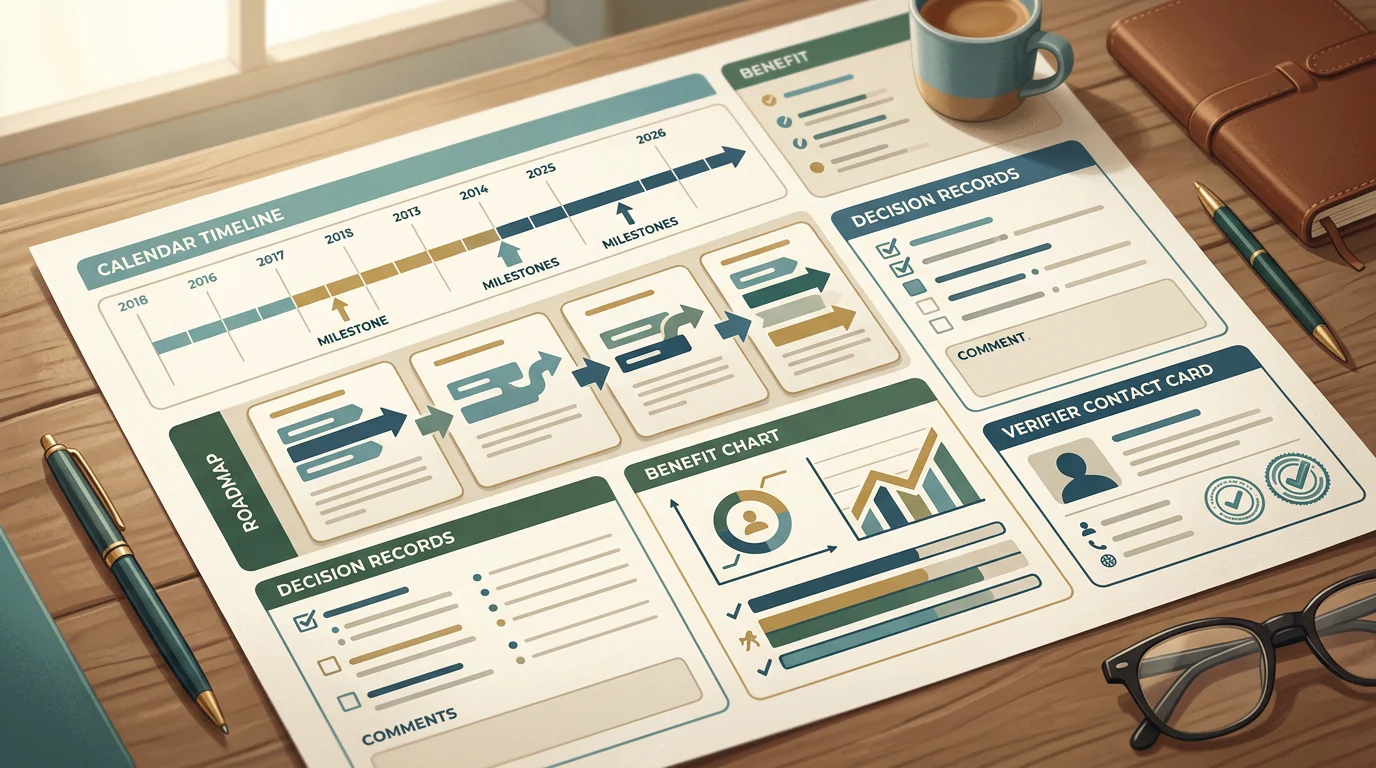
Candidates often remember the work clearly but lack a polished program file. That is normal in a fast-moving startup. We advise rebuilding an evidence map from records, then validating it before you draft the application. The goal is a truthful reconstruction, not a retrospective rewrite.
Start month by month. List each possible program, its objective, components, start and end dates, key decisions, benefits, records, and people who directly observed the work. Count overlapping time conservatively and keep separate project claims distinct from component work included in program claims.
| Evidence Field | What To Record | Useful Startup Evidence |
|---|---|---|
| Shared Objective | Strategic outcome and business reason | Planning deck, leadership memo, roadmap |
| Start And End Dates | Month and year, plus the basis for each | Calendar, release plan, contract, board update |
| Components | Related projects or workstreams | Tickets, workstream trackers, launch plans |
| Integration Decisions | Dependencies, trade-offs, sequencing | Decision notes, email approvals, meeting records |
| Governance | Who approved, rejected, funded, or escalated | Founder messages, approval records, planning notes |
| Benefits | Baseline, target, owner, result or transition | Analytics dashboard, finance report, operations data |
| Verifier | Person who directly observed your work | Former manager, sponsor, functional leader |
Retain records before you apply. A former manager or executive sponsor is a useful verifier only when they directly observed your role and can accurately confirm it. A peer can add context, but should not be asked to verify decisions or dates they did not witness.
Our domain mapping can help you organize evidence around the capabilities your summary needs to demonstrate. Use it to clarify the truth, not to turn ordinary delivery work into a program after the fact.
How Do You Write a Defensible PgMP Experience Summary?
Write the summary as a record of your personal program leadership. Reviewers need to see related components, the strategic objective, the decisions you led, the stakeholder context, and the benefit. Generic descriptions of what a program manager should do do not establish that you did it.
Use specific details without exposing confidential information. Name component types, stakeholder roles, decision criteria, risks, methods, and verified outcomes. Avoid claiming actions performed by a founder, sponsor, or team unless you can clearly describe your own contribution to that action.
| Weak Narrative | Improved Narrative |
|---|---|
| “I managed a major startup program and worked with several teams to launch our platform.” | “I coordinated product, security, customer-transition, and support-readiness components to achieve the approved platform launch outcome. I resolved a shared dependency, prepared options for the responsible executive, and tracked the agreed adoption measure.” |
| “I handled stakeholders and governance.” | “I ran the actual decision cadence, escalated a delivery risk with impact options, documented the resulting choice, and adjusted component sequencing to protect the agreed launch outcome.” |
A good summary is concrete, first-person, and proportionate to the evidence. A weak one relies on titles, adjectives, or terminology that could describe anyone’s work. Before submitting, use a neutral reviewer who will challenge unclear dates, unsupported benefits, and claims that belong to another person.
When Should You Apply for Startup Experience for PgMP Eligibility?
We recommend applying only when your timeline and evidence tell the same story. Meeting the month requirement matters, but it is not enough if the components are unrelated, the benefit is vague, or nobody can credibly verify your contribution.
| Readiness Outcome | Apply Now | Document More Evidence | Wait And Build Experience |
|---|---|---|---|
| Experience Timeline | Meets the applicable requirement with clear dates | Likely meets it, but dates or overlaps need checking | Does not meet the required program-management period |
| Program Evidence | Multiple defensible examples with related components | Some valid examples, but decisions or benefits need support | Mostly standalone projects or recurring operations |
| Audit Readiness | Records and direct verifiers are available | Records exist but need retrieval or validation | Claims depend mainly on memory |
| Next Step | Draft summaries and begin focused preparation | Complete the evidence worksheet first | Seek real cross-component leadership responsibility |
If you are halfway through a generic project-management course, do not assume that study alone proves PgMP readiness. Once your eligibility is defensible, shift your preparation toward strategy, benefits, governance, stakeholders, and integration across components. Our PMP-to-PgMP transition and PgMP study stack explain how that change in emphasis affects experienced project leaders.
How Can Augment Consultancy Help?
At Augment Consultancy, we help experienced leaders turn credible, nonstandard work into a clear PgMP application strategy without dressing it up as something it was not. We start with the hard question: do the months, related components, decisions, and benefits support a defensible claim? Then we help you map evidence, distinguish program work from standalone delivery, and prepare experience narratives that show your personal contribution. Our support is built for busy leaders who need straight answers before investing serious study time.
We do not use generic templates to retrofit a career. Instead, we help you test each claim against real artifacts, available verifiers, and the program-level decisions you actually made. When your timeline is solid, we can help you focus preparation on the judgment this credential examines. When evidence is thin, we will identify the gap so you can build real responsibility before applying. Explore Augment Consultancy
FAQs on Startup Experience for PgMP Eligibility
We answer the practical questions startup leaders ask when their experience was real but their documentation was informal. These answers should support an honest application decision.
Can Startup Experience Qualify for PgMP?
Yes. It can qualify when you coordinated related components toward a shared strategic outcome, led cross-component decisions, and can document accurate dates, benefits, and personal responsibilities.
Can I Apply Without a Formal Program Charter?
Yes. A formal charter is not required, but your application still needs credible proof of strategic intent, connected components, governance decisions, leadership actions, and measurable benefits.
Can I Qualify Without a PMO or Program Manager Title?
Yes. Titles and PMO structures do not decide eligibility. Your coordinated responsibilities, accurate timeline, personal decisions, evidence, and verified benefits determine whether the experience is defensible.
How Do I Document Informal Program Management?
Rebuild the record from real roadmaps, decisions, dashboards, messages, calendars, and transition materials. Then verify dates, component relationships, benefits, and people who directly observed your work.
Should I Switch from Generic Study to PgMP Preparation?
Switch only after your eligibility evidence is credible. Then use focused PgMP preparation to strengthen program-level judgment, including integration, governance, benefits, stakeholder engagement, and strategic alignment.